Industry — Healthcare

Patient experience solution for clinics & hospitals

Qmeter is a patient experience solution for clinics, hospitals, labs, and pharmacies: it captures patient feedback at every touchpoint — waiting-room kiosks, QR codes on the ward, SMS after the visit, web after telehealth — and routes every complaint to the person who can fix it. Patient satisfaction becomes a live number for every department, and every resolution leaves a documented trail.

Live in a day without consultants — and ready for enterprise scrutiny: PII masking, audit logs, GDPR workflows, and an on-premise option for hospital groups.

See pricing
1000+companies use Qmeter
2M+feedbacks collected
15+years in experience management
Waiting roomKiosk · Tablet
On the wardQR · Bedside
After the visitSMS · Email
The problem

Where patient experience quietly breaks

Care quality is measured rigorously. The experience around it usually isn't — and the gaps look like this.

01

Most unhappy patients never complain — they switch

A dissatisfied patient rarely fills in a complaint form. They finish the visit politely, leave, and book the next appointment somewhere else. Without a low-effort way to speak up at the point of care, the first signal you get is a falling patient count.
02

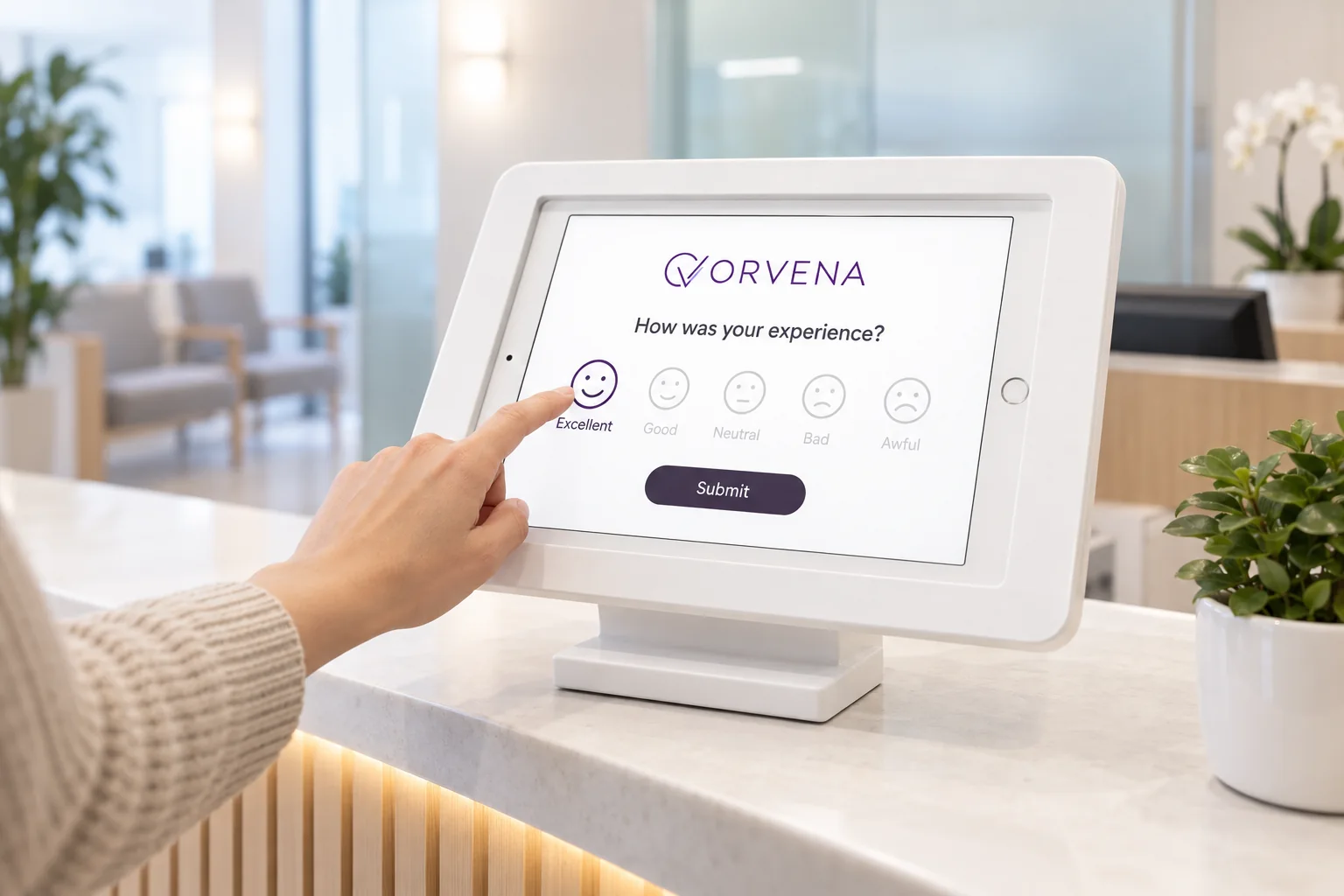
The waiting room decides how the visit feels

Patients typically judge a clinic by everything around the consultation: the queue, the registration desk, the waiting time, the signage. Clinical teams rarely see this layer — it sits between departments, so nobody owns it.

03

Departments only see their own slice

Registration, nursing, labs, and billing each see one step of the patient journey. When feedback isn't tied to a department and a date, recurring problems surface as corridor anecdotes — not as fixable patterns.

04

Complaint handling has to be provable

Quality and accreditation reviews typically ask how patient complaints are received, routed, and closed. A folder of paper forms is not evidence; a timestamped complaint-to-resolution trail is.

How Qmeter fits

How Qmeter fits a clinic or hospital group

Patient feedback at the point of care and after it — collected gently, routed firmly.

Patient experience runs on the same discipline as a closed-loop feedback process: listen at every touchpoint, route every complaint, document every fix. Qmeter runs that loop across reception, wards, labs, and telehealth — with complaint-to-ticket routing built in.

Waiting room

Kiosks in the waiting room and reception

One-tap patient feedback while the experience is still happening. Anonymous by default — which is exactly why patients actually use it. A low score alerts the duty manager the same minute.

On the ward

QR codes at the bedside and discharge desk

In-patient feedback tied to the ward and the date, so recurring themes — noise, waiting, communication — surface by unit, not by rumour.

After the visit

SMS surveys after appointments and procedures

A short survey the same day, while the visit is fresh. High response rates, and every answer linked to the clinic, department, and service that generated it.

Complaints

Complaint → ticket → clinic manager

A negative response becomes a ticket automatically, assigned to the responsible clinic manager with an SLA timer. Notes, actions, and timestamps form the documented trail quality reviews ask for.

Measure what matters

The numbers that describe patient experience

Clinical outcomes have their own KPIs. These four describe the experience around the care.

CSAT

Patient Satisfaction Score

Score each visit, ward stay, and lab test. Satisfaction by department shows where the experience breaks — registration, waiting, or the care itself.

When to use CSAT
NPS

Net Promoter Score

Would the patient recommend your facility? In private healthcare, NPS tracks the referrals and reputation your growth depends on.

NPS vs CSAT vs CES
CES

Effort Score

How hard was it to book, register, or get results? Effort is where most patient frustration lives — before and after the consultation.

CES in the glossary
SLI

Satisfaction Level Indicator

Qmeter's single-number KPI (−100 to 100): current case × 100 / best case. One score for the board — comparable across every clinic and department.

How SLI works

New to these terms? Start with the NPS vs CSAT vs CES comparison or the feedback metrics glossary.

ROI

What a patient experience programme returns

Not three borrowed statistics — your own numbers. Move the sliders; the maths is transparent and every figure comes from your inputs.

Reputation

In healthcare, trust is the product. A patient who feels unheard rarely argues — they book the next appointment elsewhere and tell family and friends why.

Catching a concern at the front desk protects two things at once: the patient relationship, and the reputation that brings the next patient through the door.

4
1,200

Sizes your plan — plans are billed by responses per year.

25

Check your complaints log — plus the patients who quietly switch provider.

600

Recurring visits, treatments and family referrals over a year.

12%

Example: if you save 10 out of every 100 you catch, set 10%.

Your estimated return
€84,150

protected per year, after Qmeter's cost

Keeping just 4 patients a year — across all 4 locations — covers the entire cost. Everything above that is return.
Patients kept per year (est.)144€86,400
Web Feedback plan — 25k responses€2,250
estimated return: over 35× what you pay

An estimate computed from your own inputs — not a guarantee or forecast of results. Adjust the sliders to match your numbers.

Two quieter returns: complaints resolved privately before they surface as public reviews (see Google reviews management), and the staff-hours that paper surveys and manual complaint chasing typically consume — collection, routing, and reminders run automatically.

Multi-location

Every clinic. Every department. One record.

Hospital groups use Qmeter to compare sites and departments on the same patient-experience scale — and to prove, with timestamps, that every complaint was routed, handled, and closed.

The same multi-location engine powers Qmeter for banks — organisations where service consistency across sites is non-negotiable.

  • Compare clinics, departments, and shifts on one dashboard
  • Route complaints to the responsible department with ownership
  • Alerts for low scores and urgent patient comments
  • Exportable feedback and resolution logs for quality reviews
Patient data

Treated like patient data, not marketing data

Feedback in a health setting can carry personal data, so protection is part of the design — not an add-on. The full control set lives on the security & GDPR page; these four matter most in healthcare.

PII masking with audited access

Personal fields are masked by default in dashboards and reports. Unmasking is permission-based, and every access is written to an audit log.

GDPR deletion workflow

Right-to-erasure requests run as a tracked workflow, not a manual hunt across databases — with confirmation when the record is gone.

Retention with anonymisation

Set how long feedback keeps its personal fields. After the retention window, records are anonymised automatically — the trend data stays, the identity doesn't.

On-premise option

Hospital groups that must keep data inside their own infrastructure can run Qmeter on-premise, behind their own security perimeter.

Qmeter is designed with sensitive health-service data in mind. It is a feedback system, not a medical-records system — it holds only what patients choose to share, under GDPR-aligned controls.

FAQ

Healthcare feedback, answered

Short, honest answers. For anything else, talk to our team.

How do hospitals and clinics collect patient feedback in real time?

With channels at the point of care: kiosks in waiting rooms and reception, QR codes at the bedside and discharge desk, tablets at nurse stations, and SMS the same day as the visit. Responses appear in the dashboard the moment they are submitted, and low scores alert the responsible department immediately.

Keep exploring

Qmeter across industries and resources

Get started

Hear every patient. Document every fix.

Waiting-room kiosks, ward QR, and post-visit SMS in one patient experience system — with complaint routing and records your quality team can stand behind. 14-day free trial, no credit card.

See pricing
We use cookies to improve your experience. 
You can
opt out of certain cookies. 
Find out more in our privacy policy
AI Cookie