Store-vs-store blind spots
Revenue tells you a store underperforms months after the service slipped. Without per-store feedback you cannot see which till, shift, or aisle started the decline — or which store's playbook is worth copying.
Qmeter is retail customer feedback software that collects shopper feedback at the moment of experience — through kiosks at the exit, QR codes on receipts, SMS after delivery, and email and web surveys after online orders. AI analysis and store-by-store comparison show exactly which locations delight customers and which quietly lose them.
Built for chains and multi-store operators: one dashboard for every store, region, and channel, with alerts the moment a location drops.
Trusted by brands like Volkswagen and Hyundai.
Four blind spots we see across store networks — none of them show up in the revenue report until it is too late.
Revenue tells you a store underperforms months after the service slipped. Without per-store feedback you cannot see which till, shift, or aisle started the decline — or which store's playbook is worth copying.
Most unhappy shoppers say nothing at the till. They simply do not come back — and tell a few people why. The only way to keep them is to catch the moment they feel let down, while they are still in the store.
A handful of staged visits per quarter cannot represent thousands of real transactions. Real shopper feedback, captured continuously, gives you the sample size mystery shopping never will.
By the time a one-star review is public, the moment to recover that shopper is gone. Feedback collected in the store, during the visit, gives your team a chance to fix things first.
Feedback collection that matches how people actually shop — in store, at the door, and online.
Retail journeys cross channels constantly: browse online, buy in store, return by courier. Qmeter ties them together with omnichannel feedback collection — every response, from every channel, lands in one dashboard and stays comparable.
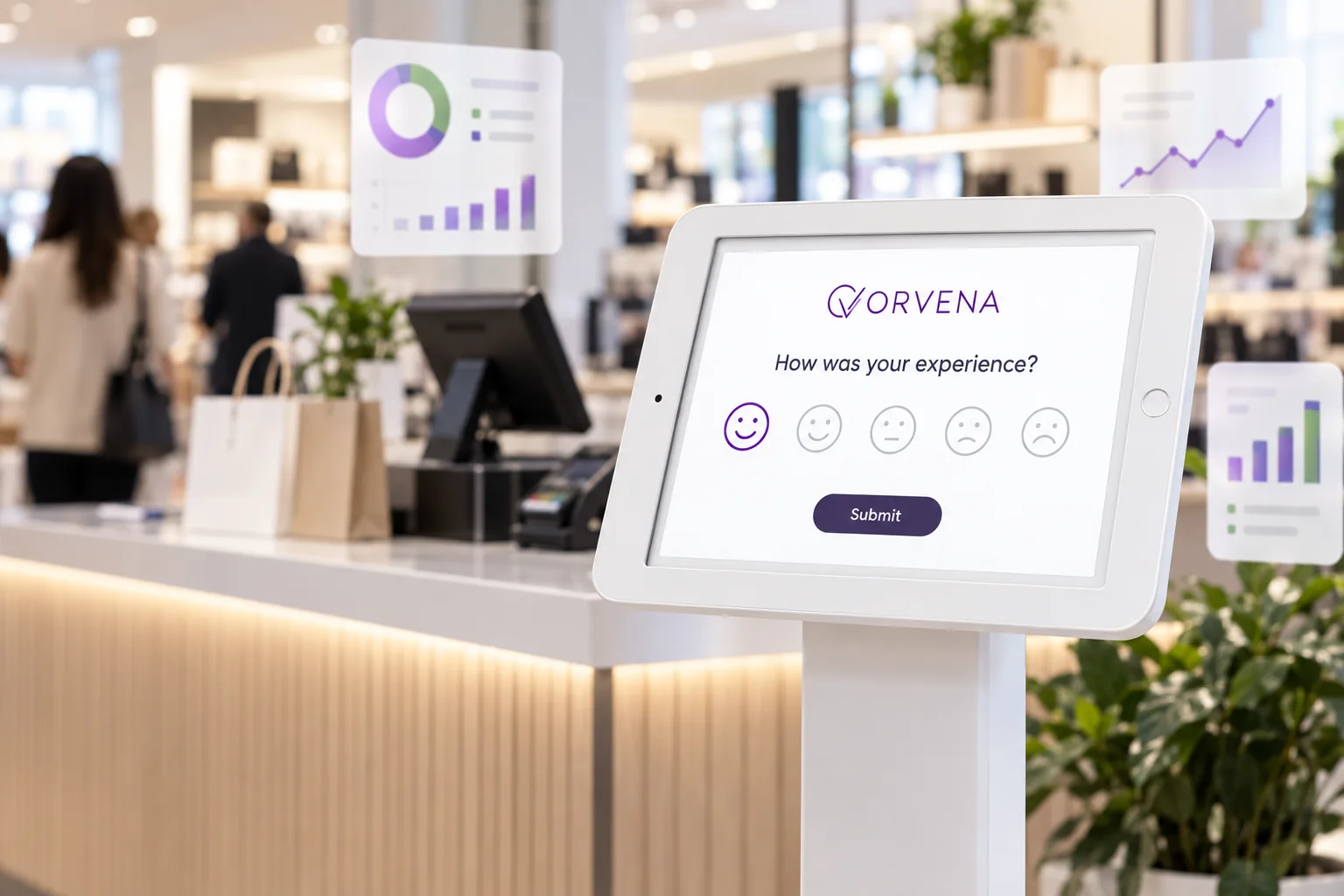
A one-tap kiosk captures how the visit went while the shopper is still in the store. High response volume, zero staff effort, anonymous by default.
Shoppers scan and answer in seconds — no app, no login. Each response is tied to the store, till, or department that generated it.
Transaction-based SMS reaches the customer right after handover, while the experience is fresh and specific enough to act on.
Cover the digital half of the journey with the same questions, so online and in-store scores stay comparable in one report.
Pick the right KPI per journey — one system keeps them comparable across every store.
The workhorse of the store floor. Score every visit, till interaction, and fitting-room experience — then rank stores by it daily.
When to use CSAT →Ask it after the relationship moments — loyalty sign-ups, repeat purchases, returns handled well — to track whether shoppers would recommend you.
NPS vs CSAT vs CES →Measure how hard it was to find a product, return an item, or collect an order. Effort predicts churn in retail more than delight does.
CES in the glossary →Qmeter's own single-number KPI (−100 to 100): current case × 100 / best case. One score to compare every store, every week, on one leaderboard.
How SLI works →New to these terms? Start with the NPS vs CSAT vs CES comparison, the Voice of Customer guide or the customer experience glossary.
One cited finding, then your own numbers. Move the sliders; the maths is transparent and every figure comes from your inputs.
PwC found that almost a third of customers will walk away from a brand they love after a single bad experience.
PwCIn retail that one experience is a long queue, a rude interaction or an unanswered complaint — and a competitor is one street away. Catching it at the till is the cheapest save there is.
Sizes your plan — plans are billed by responses per year.
The unhappy shoppers you catch — plus the ones who leave without a word.
The repeat baskets one household brings over a year.
Example: if you save 10 out of every 100 you catch, set 10%.
protected per year, after Qmeter's cost
An estimate computed from your own inputs — not a guarantee or forecast of results. Adjust the sliders to match your numbers.
Two quieter returns: an underperforming store surfaces on the dashboard mid-quarter — while there is still time to fix the shift, the layout, or the process — rather than in the quarterly revenue report; and a complaint resolved at the till is a one-star review that never gets written (see the closed-loop feedback process).
Multi-location comparison is Qmeter's home ground. Every store reports into the same dashboard, so 'how are we doing?' has one answer — per store, per region, per shift.
The same comparison engine powers Qmeter for banks, where branch networks track service quality across entire countries.
Collect it at the moment of experience, not days later. A kiosk at the exit and a QR code on the receipt typically capture far more responses than a survey emailed after the shopper has left — and Qmeter combines both with SMS, email, and web channels in one omnichannel system.
Kiosk mode, offline capture and device monitoring for CSAT at the point of experience.
→Branch feedback, queue experience, and network-wide comparison for banking.
→Catch guest problems at the table or in the room — before the review goes public.
→Patient experience measurement with documented follow-up across clinics.
→Post-call and post-installation feedback that catches churn early.
→How to combine kiosk, QR, SMS, email, and web collection without chaos.
→Start collecting shopper feedback this week — kiosks, QR, SMS, and web in one system, with every store on one scoreboard. 14-day free trial.