Trust is built at the counter
A citizen's opinion of the state is formed in queues, at desks and on portals — one interaction at a time. Measuring those interactions is the only way to know whether trust is growing or eroding.
A citizen experience solution lets governments and public institutions measure citizen satisfaction at every touchpoint — service centres, e-government portals, municipal offices, hospitals and utilities — instead of assuming it. Qmeter's citizen feedback platform collects verified feedback through kiosks, QR, SMS and web, analyses it with AI, and routes every complaint to the responsible department with SLA timers and a full audit trail.
Citizen experience has to be measured and verified, not assumed. Measured feedback becomes better services; better services become happier citizens — and that is what social stability and economic development are built on.

Governments already measure budgets, headcounts and processing volumes. The missing number is how citizens actually experienced the service.
Experience with public services shapes overall trust in institutions. The method for capturing those experiences systematically is covered in our citizen experience measurement guide — here is why it belongs on a government dashboard.
A citizen's opinion of the state is formed in queues, at desks and on portals — one interaction at a time. Measuring those interactions is the only way to know whether trust is growing or eroding.
Annual polls arrive too late and average away the problems. Verified, transaction-level feedback shows exactly which office, which service and which week went wrong — while it can still be fixed.
Measured feedback drives better services; better services make happier citizens; and happier citizens support social and political stability — the ground economic development is built on.
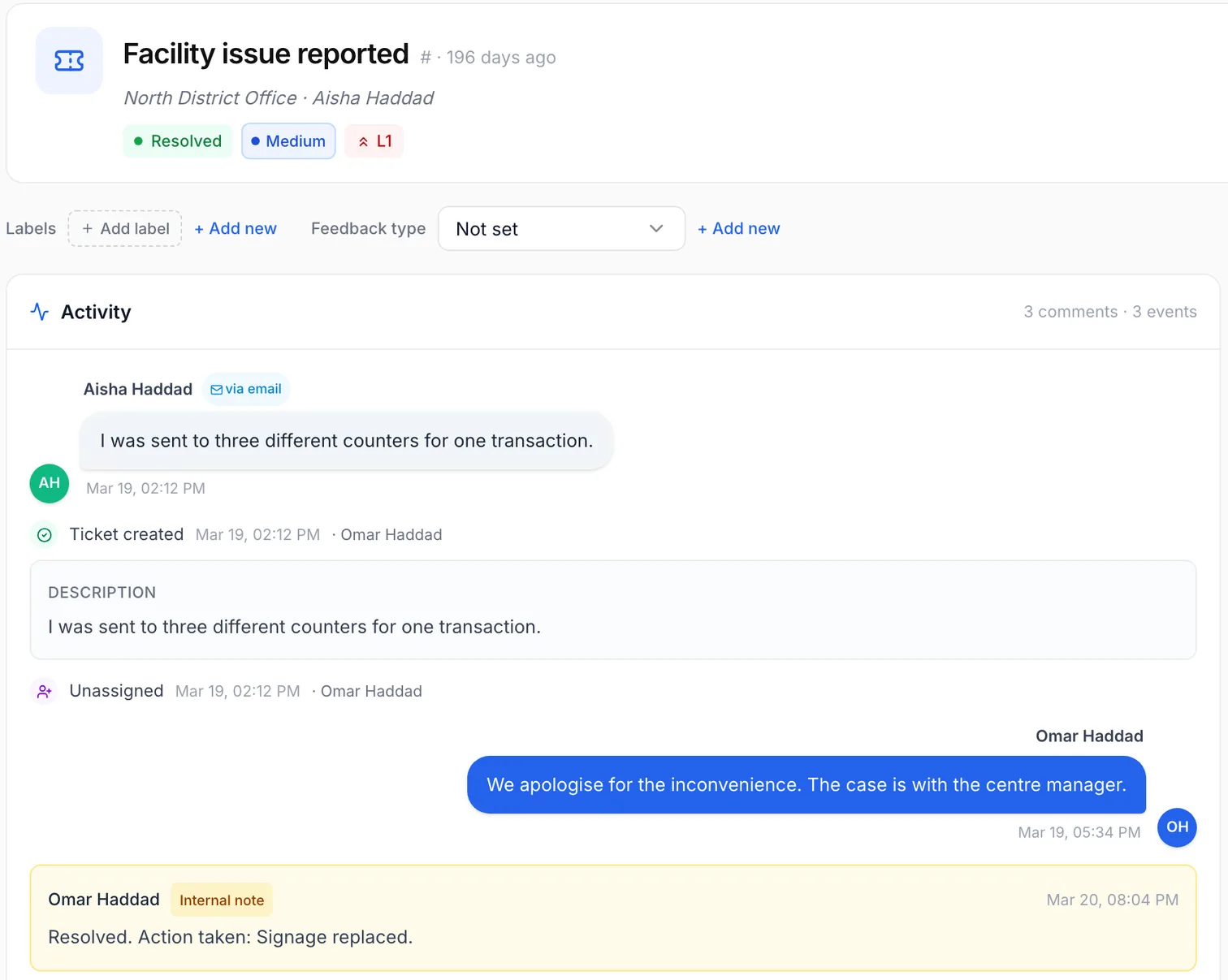
When every complaint has an owner, a deadline and an audit trail, “we are looking into it” becomes a tracked case. Departments answer for outcomes, not intentions.
Satisfaction per agency, region and service is a management KPI a government can set targets on — and publish. What is measured and verified can be improved and defended.
Front-line teams get real-time scores for their own centre, not a ministry average. Public servants are also an audience — pair citizen data with employee experience measurement.
Wherever the state meets the citizen — from a single municipality to a national programme — each response is tied to a real, completed interaction, so the data stands up to scrutiny. See the full channel playbook in our omnichannel feedback collection guide.
Running a town hall or a council? The local government feedback tool page shows how one municipal office starts and every department joins later.


A kiosk or tablet at the exit captures every visitor's rating, tied to the desk and service. Works offline and syncs later — connectivity in a district office is never a blocker.
Learn more →SMS / EmailA short survey lands seconds after a permit, certificate or payment is issued. Response rates are highest when the transaction is still fresh — and each answer is tied to a real case.
Learn more →QRA QR code at any counter, ward or payment office opens a 30-second survey in the citizen's own language — no app to install, nothing for staff to hand out.
Learn more →WebEmbedded feedback on e-gov portals catches friction where digital services fail silently — abandoned applications, confusing forms, broken flows.
Learn more →AIAI reads open comments — with translation across 100+ languages — and surfaces the recurring themes: waiting time, staff conduct, document errors, accessibility.
Learn more →One systemKiosk, SMS, QR and web responses land in one place, comparable across agencies and regions. See how the channels combine in our omnichannel collection guide.
Learn more →Collection is the easy half. What makes citizens feel heard is what happens in the hours after they tap the angry face.
A negative response automatically opens a case through closed-loop ticketing: rules route it to the right department and a named owner, an SLA timer starts, and if the deadline slips the case escalates up a defined chain — automatically.
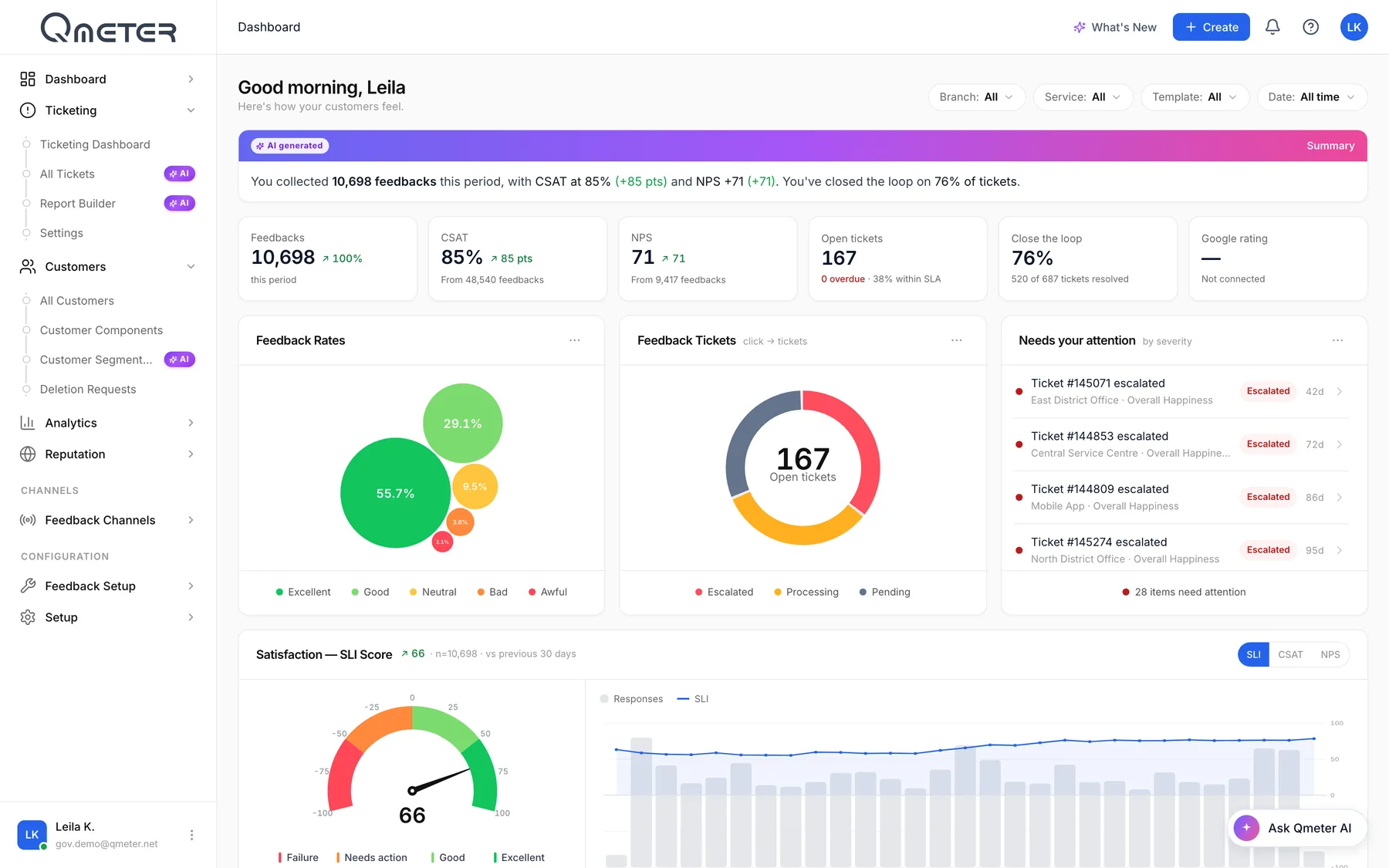
Leadership sees one comparable score — SLI (Satisfaction Level Indicator) — per agency, region, office and service, updated in real time. AI reads the comments underneath and names the recurring themes, so a low score always comes with a reason.
Citizen feedback can contain personal data. The platform that holds it must meet the state’s own standard — in infrastructure, in law and in auditability.
Qmeter runs fully inside government infrastructure — no data leaves servers the state controls. Details on our integrations & on-premise page.
PII masking, deletion workflows, retention rules with anonymisation, and role-based access — see security & GDPR for the full model.
Every case change, assignment and resolution is logged. When an oversight body asks how a complaint was handled, the answer is a record, not a recollection.
AI analysis is built so that raw personal data is not sent to the model — analysis works on the content and structure needed for the task, nothing more.
Short, honest answers. For procurement questions or a pilot proposal, talk to our team.
By capturing feedback at the moment of service, not months later in a poll. Place kiosks and QR codes in service centres and municipal offices, trigger a short SMS or web survey after each e-government transaction, and centralise every response per agency, region and service. Each answer is tied to a real, completed interaction, so the numbers are verifiable. Our citizen experience measurement guide covers the full method step by step.
Exit kiosks and counter tablets for service centres, offices and clinics.
→Start with one municipal office; every department joins the same dashboard.
→Owners, SLA timers, escalation and an audit trail for every complaint.
→SMS, email and portal surveys after every online transaction.
→The full platform: builder, channels, analytics and customer profiles.
→The complete method: what to measure, verified feedback vs opinion polls, and how to start.
→PII masking, audit trails, retention and deletion workflows — protections built for sensitive data.
→Run Qmeter inside government infrastructure, integrate with e-gov systems via API.
→How complaints become tracked, SLA-timed cases with escalation chains and root-cause analytics.
→Public servants have an experience too — eNPS and pulse surveys for government teams.
→Pilot one service centre in days, not budget cycles — 14-day free trial. AI builds your first citizen survey from your service profile; on-premise options are available for larger programmes.