Named owner, real deadline
Routing rules assign each case to a department and a person based on the office, the service and the severity. An SLA timer starts at creation — not when someone happens to read the email.
Citizen complaint management software turns every complaint — from a kiosk, a QR code, a web form or a call — into a tracked case with a named owner, an SLA deadline, an escalation chain and an audit trail. Qmeter opens the case automatically from the feedback itself, so a complaint cannot be lost, ignored or quietly closed.
Collecting complaints is the easy half. What citizens judge is what happens in the hours after they complain — and what an oversight body can later verify.

Shared mailboxes, paper registers and hotline notes all fail the same way: nobody is accountable for the outcome, and nobody can prove what was done.
Routing rules assign each case to a department and a person based on the office, the service and the severity. An SLA timer starts at creation — not when someone happens to read the email.
If the first-response or resolution deadline slips, the case moves up a defined chain — supervisor, head of centre, director — automatically. The system chases; people decide.
Every assignment, comment, status change and resolution is written to an audit trail. When an ombudsman, an auditor or a minister asks how a case was handled, the answer is a record.
The case is created by the feedback, not by a clerk copying it into a register.
A bad rating on a kiosk, a QR survey, a web form or a post-call SMS triggers a rule: a case opens with the citizen's comment, the office, the service and the channel already filled in.
The rule picks the department and owner; priority sets the SLA. First response and resolution are timed separately. Missed deadlines escalate up the chain and appear on the dashboard as overdue.
Closing a case requires a root cause and the action taken. After resolution the citizen is asked whether the problem was actually fixed — the recovery rate is a tracked KPI.
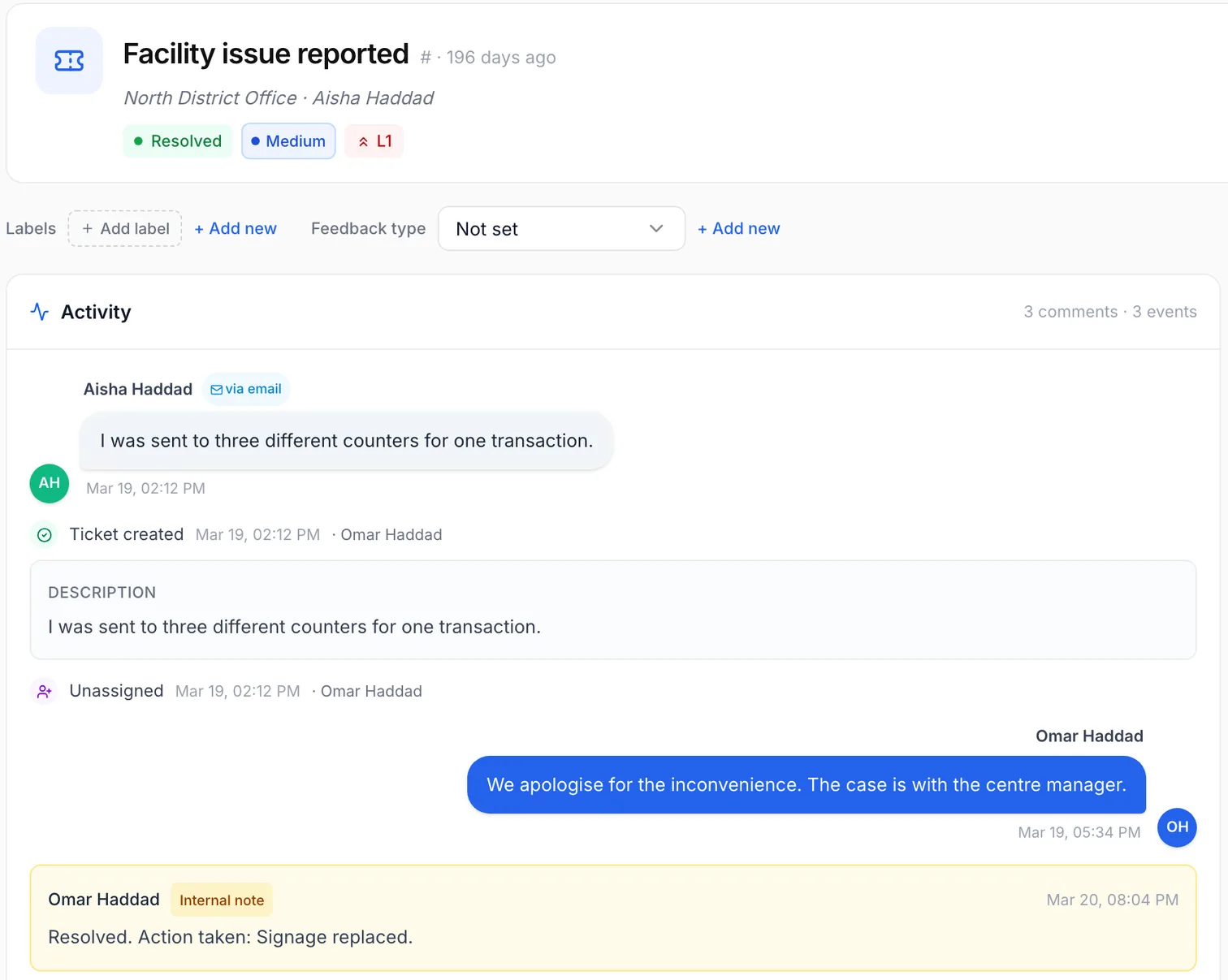
The same case, two views: the conversation and the evidence for the officer; the queue, the SLA and the recovery rate for management.
The case view holds the citizen's original complaint, every reply sent, internal notes, assignment changes and the final root cause and action — with first-response and resolution SLA shown against the deadline.
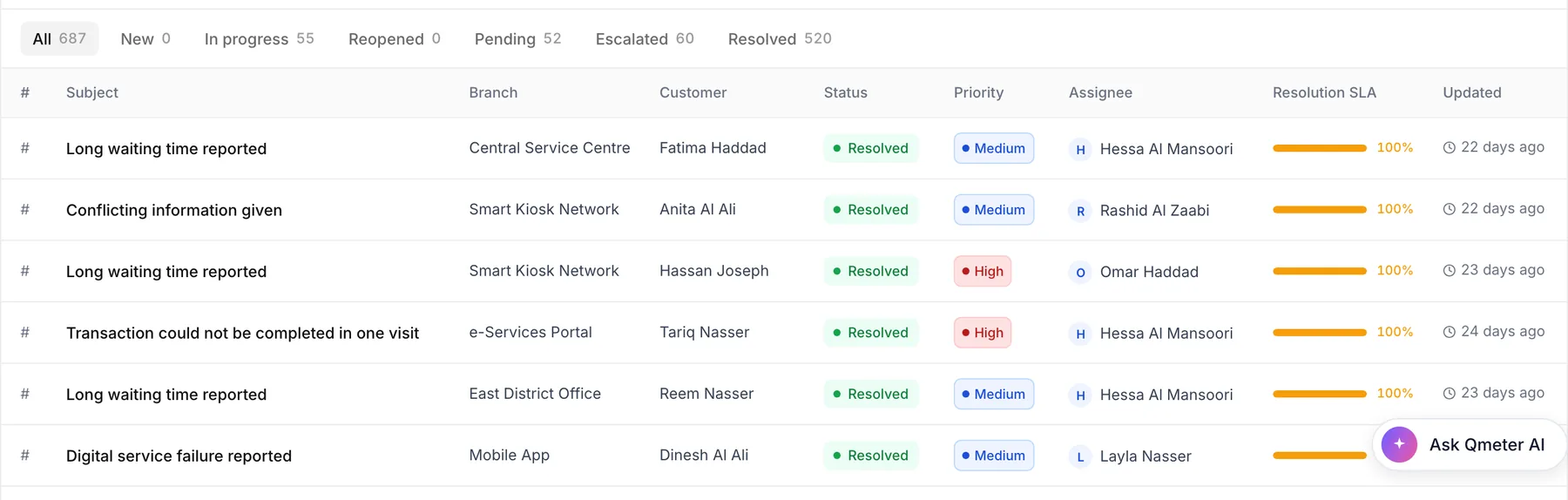
The All Cases view shows every open complaint with its office, owner, priority and how much of the SLA has elapsed. Filters by office, status and assignee make the morning review a five-minute job.
The process elements that complaint-handling standards such as ISO 10002 describe — receipt, acknowledgement, tracking, escalation, closure and review — map directly onto the case workflow.
The case is timestamped at creation and the first response is timed separately, so acknowledgement is measurable, not assumed.
Status, owner and deadline are visible on every case; escalation is automatic when a deadline slips.
Root cause and action taken are mandatory fields; the audit trail cannot be edited after the fact.
Root-cause analytics show which failures repeat and where, so the fix is a process change, not a one-off apology.
Short, honest answers. For a workflow walkthrough with your own cases, talk to our team.
Automatically from feedback: a low rating on a kiosk, a QR or web survey, a post-call SMS or an embedded portal form opens a case through a rule you define. Cases can also be created manually by staff, for example from a letter or a phone call.
The full citizen feedback platform: collection, accountability, data sovereignty.
→The ticketing engine behind the case workflow: rules, SLA, escalation, root cause.
→Where most complaints start: one tap at the exit of the service centre.
→Complaint handling for a municipality that starts with one office.
→PII masking, audit trails, retention and deletion workflows.
→What closing the loop means in CX and how to run it.
→Run the case workflow on one office's complaints for 14 days — free trial, no consultants; on-premise deployment available for national programmes.