On-premise deployment

On-premise customer feedback platform for enterprises and governments

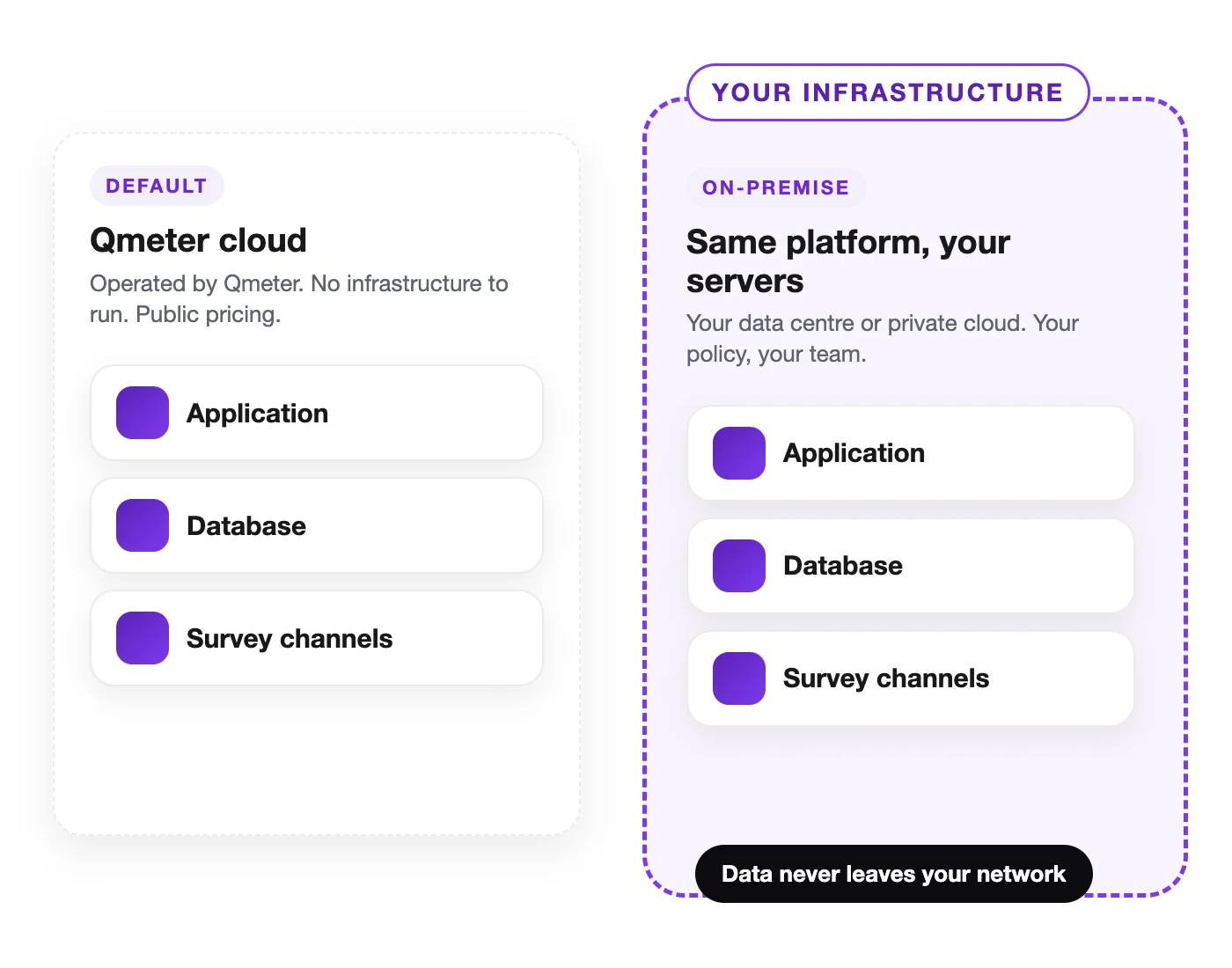
Qmeter can be deployed entirely inside your own infrastructure: application, database and every survey channel run in your data centre or private cloud, behind your firewall, under your security policy. Customer data never leaves your network, and the platform is the same as our cloud edition, with nothing removed.

For organisations whose law, regulator or internal policy decides where customer data may live: government bodies, banks and insurers, healthcare groups and operators of critical infrastructure.

Security and GDPR details

30 minutes with your IT, security and CX leads. We bring the architecture and requirements in writing.

1000+companies use Qmeter
2M+feedbacks collected
17+years in customer experience
IT director and head of customer experience talking in a glass-walled data centre corridor
Definition

What on-premise means for a feedback platform

An on-premise feedback platform runs inside the customer's own infrastructure instead of the vendor's cloud. Surveys, answers, comments, customer records and audit logs are stored and processed where the customer decides.

  • Data residency: the database sits in your country and your facility.
  • Network control: no inbound connection from the vendor; access only when you grant it.
  • Full product: the same platform as the cloud edition, not a reduced version.

How the cloud edition protects data: security and GDPR.

Two ways to run Qmeter: the vendor cloud, or on-premise inside the customer's own data centre or private cloud
Fit check

Is on-premise the right choice for you?

An honest answer before you book a call. Most organisations run Qmeter in the cloud; on-premise is for the cases below.

A strong fit when

  • A law, regulator or internal policy requires customer data to stay in your country or your data centre.
  • Customer-facing systems may not run on external SaaS, or the network is restricted or isolated.
  • The platform must reach internal systems that are not exposed to the internet: CRM, ITSM, data warehouse, your own SMS and email gateways.
  • Your security team needs to review architecture, access and controls before anything goes live.
  • You have an IT operations team that runs servers and change management.
Not the right choice when

  • There is no team to run infrastructure. The cloud edition gives you the same product without operations work.
  • You need to be live this week. On-premise follows your procurement, security review and infrastructure timeline.
How a deployment runs

From a policy requirement to a platform your team operates

Four stages. Each one produces a document your IT and security teams can review and sign off.

01

Architecture and requirements

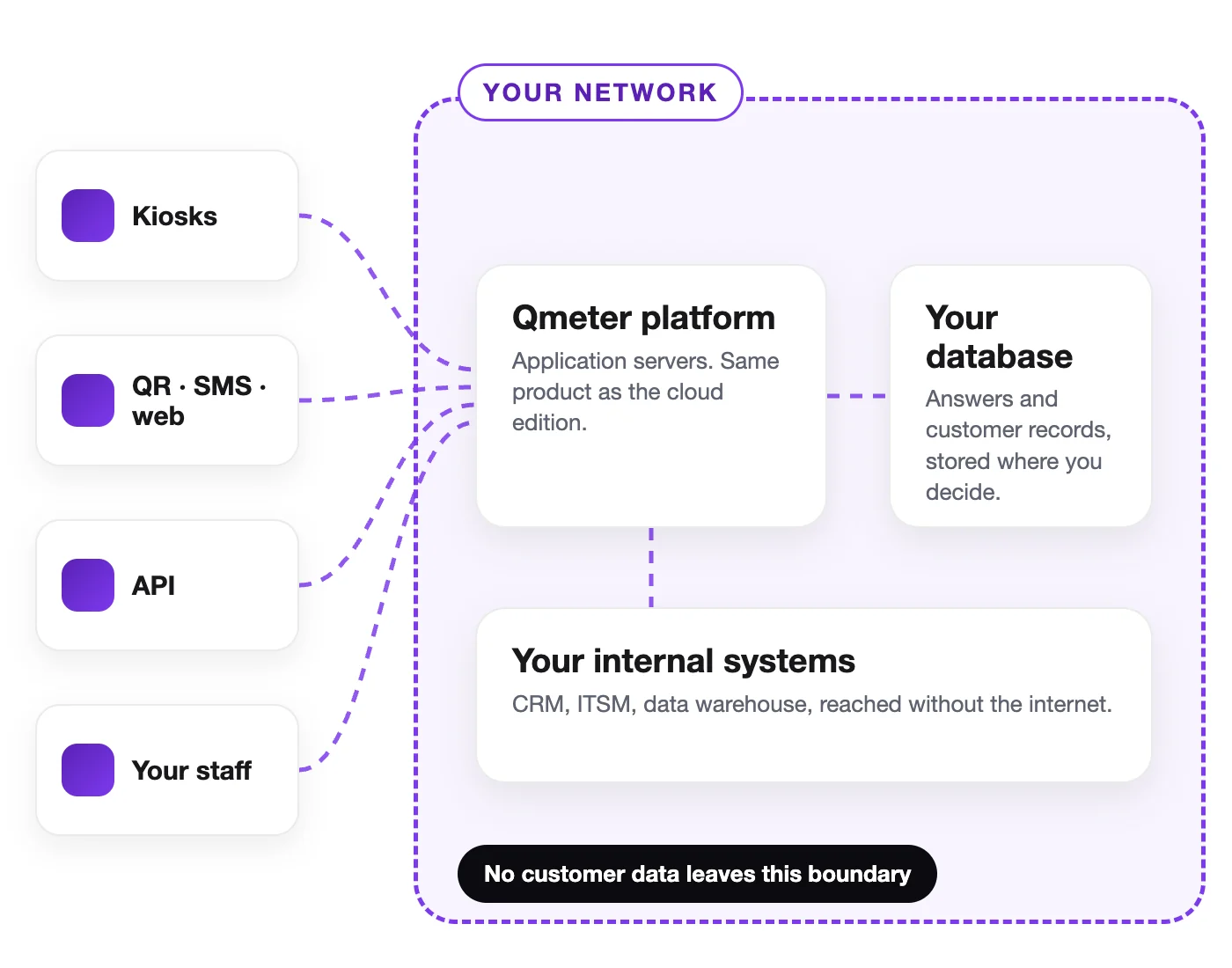
On a technical call we map the platform to your environment: application servers, database, survey channels and integration points, all inside your network. You receive the requirements and sizing in writing.

On-premise architecture: kiosks, QR, SMS, web and API feeding the Qmeter platform and the customer's database, all inside the customer network
02

Security and privacy review

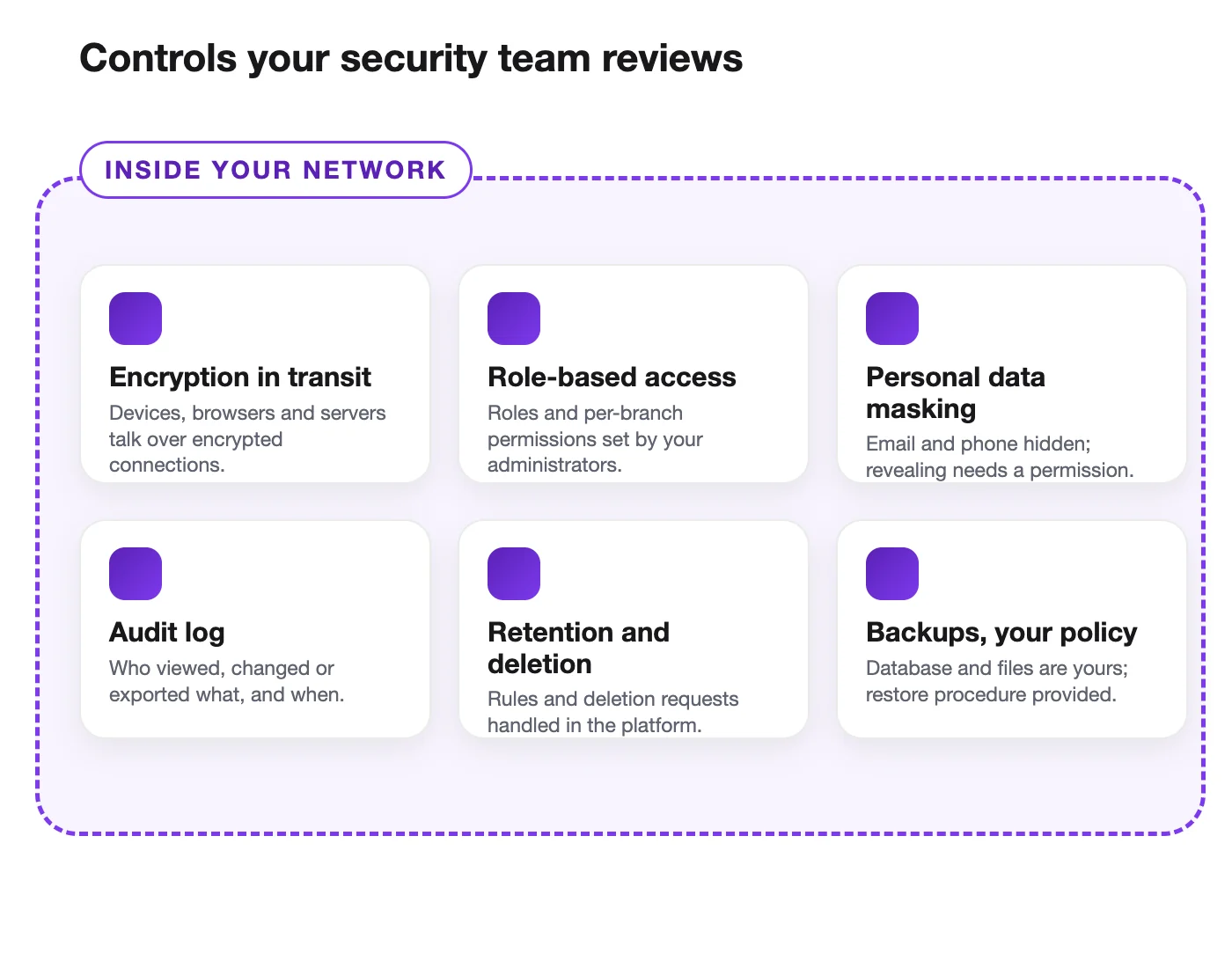
Your security team reviews the controls: encryption in transit, role-based access with per-branch permissions, masking of personal data, audit log, retention and deletion rules. Backups and disaster recovery follow your own policy.

Security and privacy controls inside the customer network: encryption in transit, role-based access, PII masking, audit log, retention and deletion, backups under the customer's policy
03

Installation and internal integration

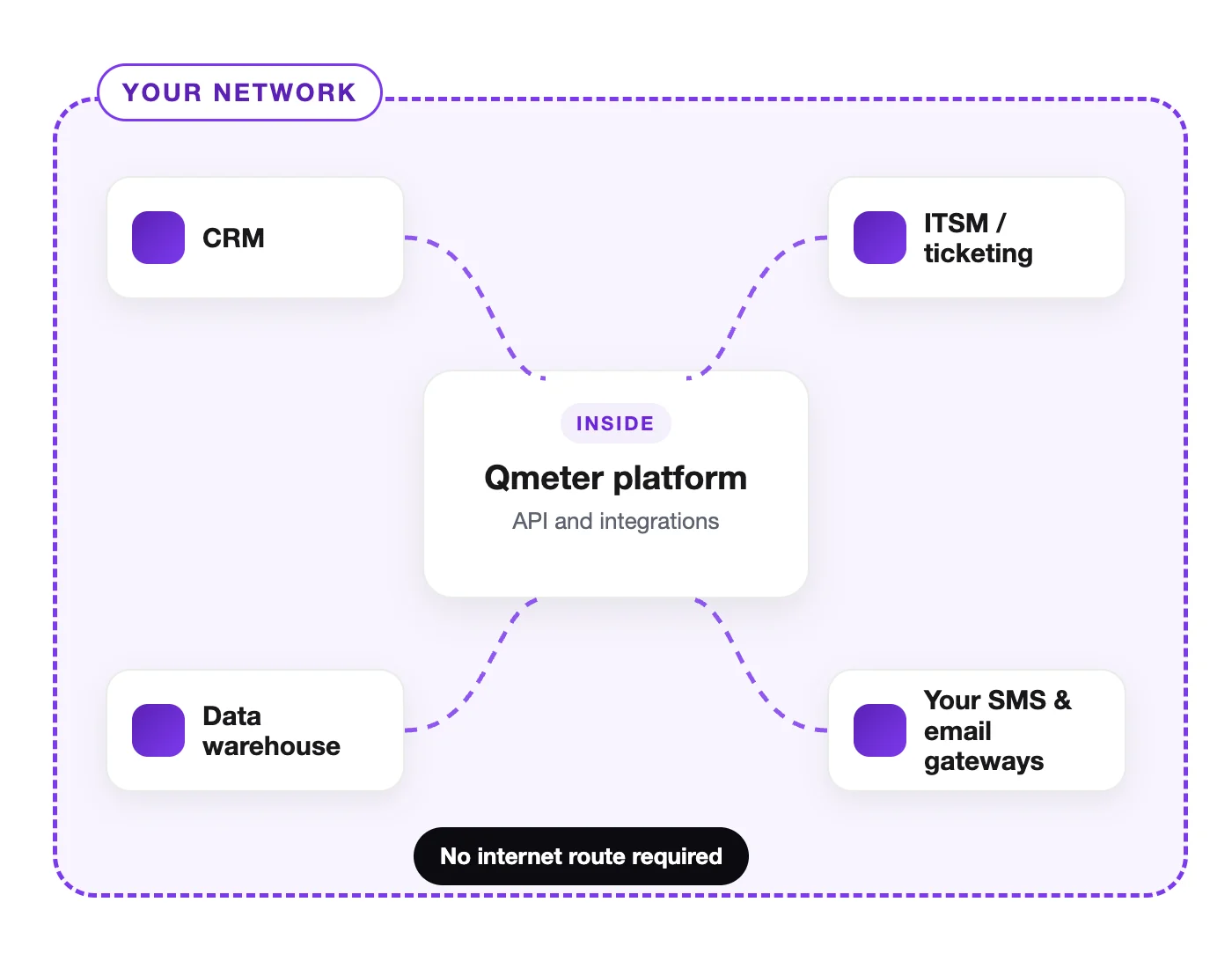
The platform is installed with your IT team on your servers or private cloud. CRM, ITSM, data warehouse and your own SMS and email gateways are connected inside the network, without an internet route.

Internal integrations: Qmeter connected to CRM, ITSM, data warehouse and the customer's own SMS and email gateways without an internet route
04

Operation and updates

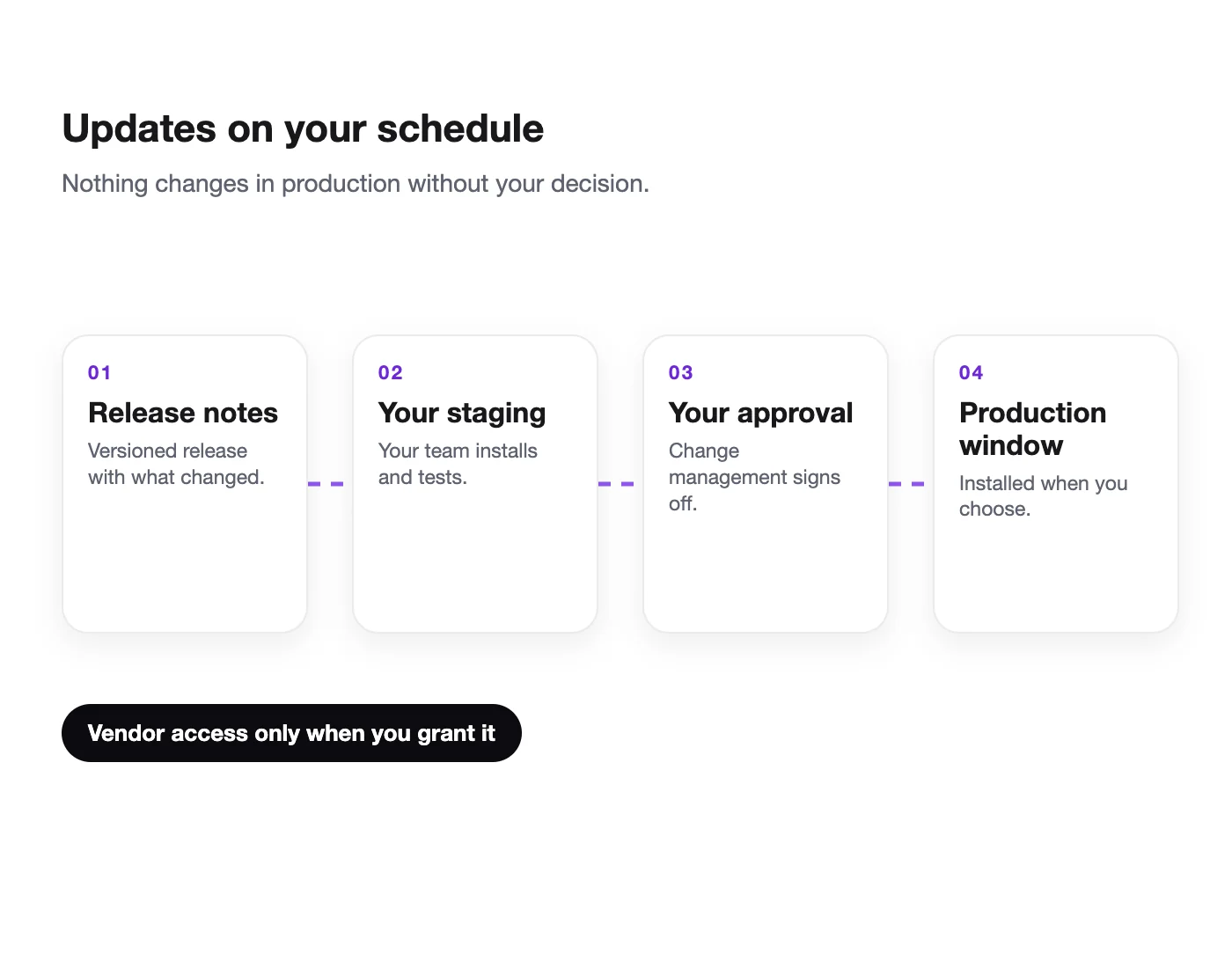
Your team operates the platform. Releases arrive with release notes, go through your staging and your approval, and are installed in a production window you choose. Vendor access happens only when you grant it.

Release process for on-premise: release notes, the customer's staging, the customer's approval, then a production window on the customer's schedule
Where it runs

Who requires on-premise

Four kinds of organisations where the location of customer data is decided before the platform is.

What is included

What the deployment covers

The controls and guarantees your review will ask about.

Data residency

Database, files and logs stored in your facility and your country.

Network isolation

Runs behind your firewall; no inbound connection from the vendor.

Encryption in transit

All traffic between devices, browsers and the platform is encrypted.

Role-based access

Roles and per-branch permissions managed by your administrators.

Personal data masking

Email and phone are masked; revealing them needs a permission and is logged.

Audit log

Who viewed, changed or exported what, and when.

Retention and deletion

Retention rules and deletion requests handled inside the platform.

Internal integrations

API reaches CRM, ITSM and data warehouses that are not on the internet.

Learn more →

Updates on your schedule

Release notes, your staging, your approval, your production window.

How it compares

On-premise, private cloud or vendor cloud?

Three ways to host a feedback platform, and what each one means for control.

Qmeter on-premiseVendor cloud (typical)
Where customer data livesYour data centre or private cloud, your countryThe vendor's cloud, often in another jurisdiction
Network exposureBehind your firewall; no inbound vendor connectionPublic internet endpoints operated by the vendor
Who operates itYour IT team, with our supportThe vendor
Feature setIdentical to the cloud editionSelf-hosted editions in the market are often reduced
UpdatesOn your schedule, after your approvalContinuous, decided by the vendor
Reach into internal systemsDirect, inside the networkThrough exposed endpoints or middleware

General observations about hosting models, not claims about any named vendor. Your own requirements decide; we put ours in writing before you commit.

Data protection

Privacy and confidentiality, by design

Hosting decides where data lives. These controls decide who can see it.

Anonymous by default

Ratings carry no personal data; identifying fields are added only when you decide.

Masking and permissions

Personal data is masked in the interface; revealing it requires a permission and writes an audit event.

AI with a data boundary

AI reports work on the data structure, not on customer answers, and can be switched off in isolated deployments.

Your data stays yours

Everything stored in your database belongs to you and remains available to you at the end of the contract.

The cloud edition's data-protection details are on the security and GDPR page; the on-premise architecture and requirements are shared in writing on request.

FAQ

On-premise deployment, answered

Short, honest answers. For anything else, talk to our team.

Where is customer data stored in an on-premise deployment?›

In your own database, on your servers or private cloud, in your country and your facility. Answers, comments, voice and video, customer records and audit logs never leave your network.

Keep exploring

Where to go deeper

Get started

Bring your IT and security team to the first call

Thirty minutes: the architecture, the controls, the requirements. You leave with documents your team can review, not a sales deck.

Security and GDPR details