Airport Passenger Satisfaction Survey: How to Run One, Step by Step

An airport passenger satisfaction survey asks travellers to rate each stage of their journey — access, check-in, passport control, security, wayfinding, facilities, the terminal environment and arrival — so the airport can see where the experience breaks down. Most airports combine two sources: an industry benchmark such as ACI’s Airport Service Quality (ASQ) programme, and their own continuous touchpoint feedback that shows which zone and hour to fix.
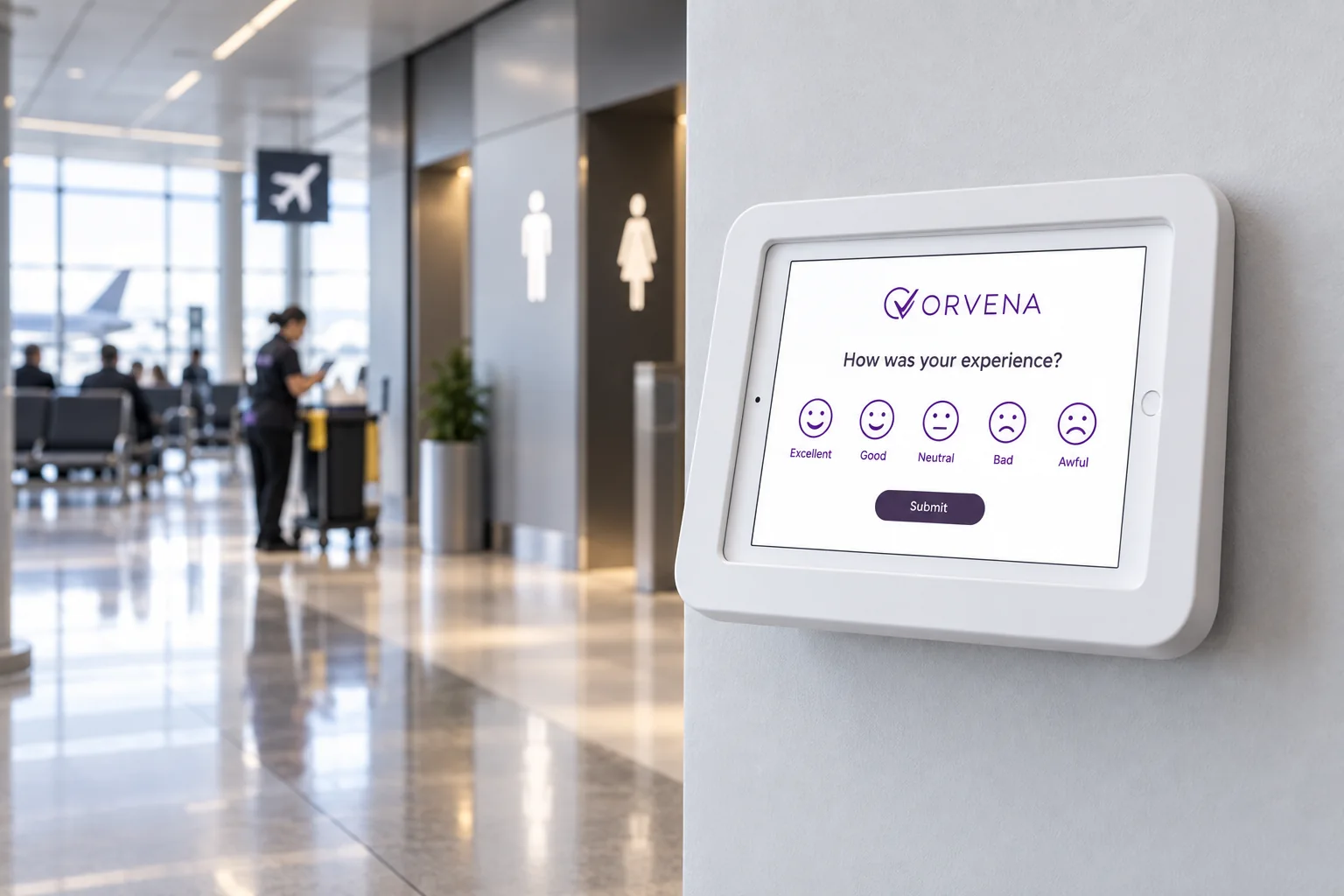
Treat the benchmark survey as the scoreboard and your own survey as the instrument panel. Ask one short question at each touchpoint, tag every answer with terminal, zone and hour slot, and map your questions to the same eight categories ASQ uses, so both data sets speak the same language.
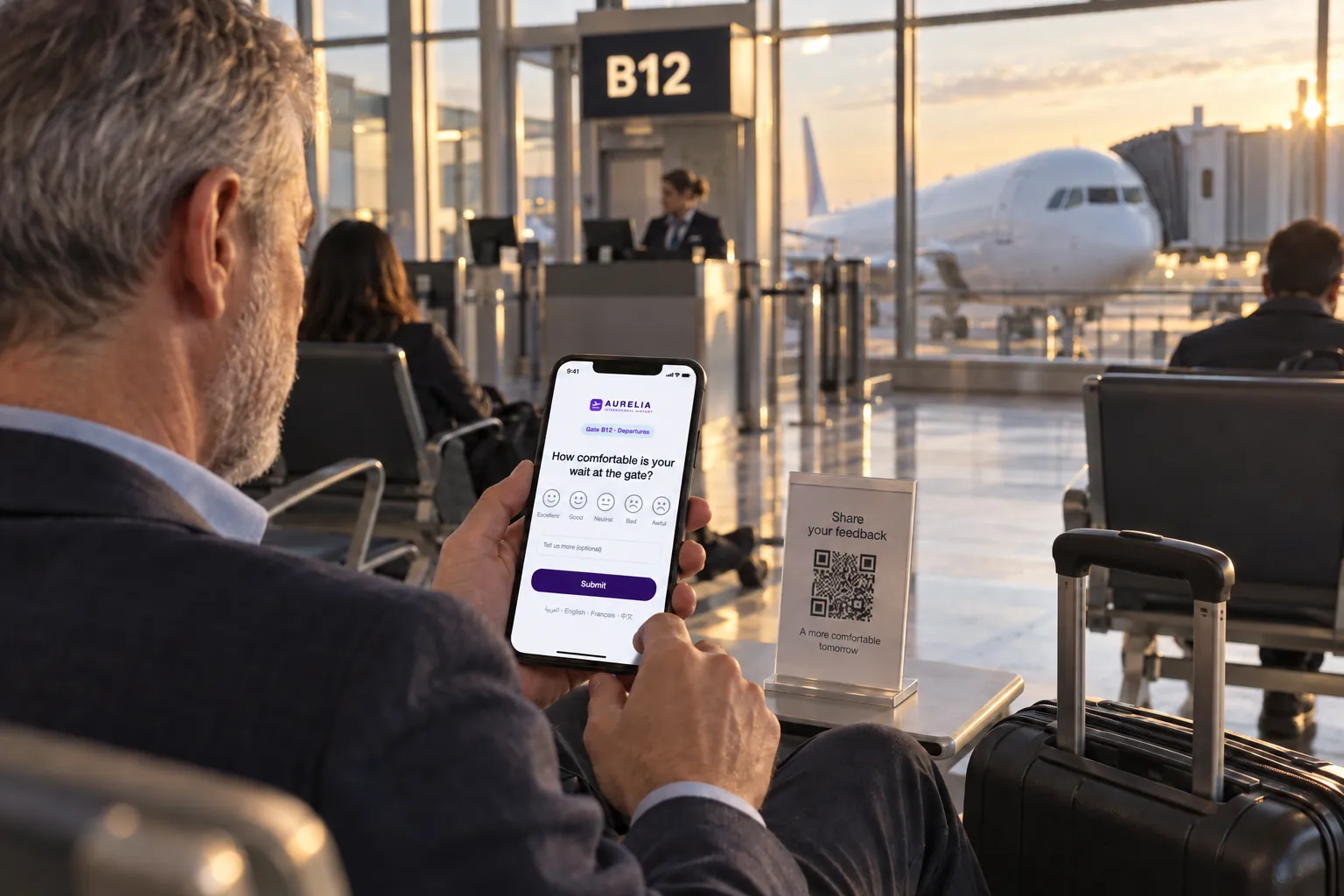
Every answer is tagged by zone and hour, and a low score becomes a ticket for the team on duty.
See the passenger feedback system →How to run a passenger satisfaction survey in seven steps
- Set the objective and the owners. Decide what the survey must change — washroom cleanliness, security waits, wayfinding — and name the team that owns each zone. A score nobody owns is a statistic, not a programme.
- Map touchpoints and zones. Walk the journey from kerb to gate and from aircraft door to exit. List each touchpoint, the zone codes inside it and the terminal, so every answer can be tagged automatically.
- Write one question per touchpoint. Ask about the moment that just happened, in plain words, with no double questions. Use the question bank below as a starting point.
- Choose the scales and keep them fixed. Five faces or 1–5 for satisfaction, 0–10 for recommendation, yes/no for facts. Changing a scale later breaks the trend line.
- Plan languages, access and sampling. Offer every language your main routes bring, make terminals reachable from a wheelchair, and check that each zone collects enough answers per departure bank to compare hour slots.
- Pilot in two or three zones. Run two to four weeks in contrasting zones — a washroom block, a security checkpoint, a gate area — and adjust placement and wording before rolling out.
- Report, alert and act. Daily views for duty managers, weekly zone comparisons for management, alerts and tickets when low scores cluster, and a check in the following weeks that each fix moved the score.
Survey questions for each stage of the passenger journey
Use these as a question bank, not a questionnaire. On a terminal or QR code, ask one question per touchpoint; in a post-trip email, pick five or six across the journey. Rating questions work on a five-face or 1–5 scale, the recommendation question on 0–10. The first eight groups follow the ASQ categories, so your data lines up with the benchmark.
Airport access
- How easy was it to get to the airport today?
- How would you rate parking — availability, signage and value for money?
- How easy was it to find the drop-off and pick-up areas?
Check-in
- How would you rate the waiting time at check-in?
- How helpful were the check-in staff?
- How easy was the self-service check-in or bag drop to use?
Passport & ID control
- How would you rate the waiting time at passport control?
- How courteous and helpful were the staff at passport control?
- How clear were the instructions before you reached the desk or e-gate?
Security
- How would you rate the waiting time at security?
- How courteous and helpful were the security staff?
- How clear were the instructions for preparing your bags?
Finding your way
- How easy was it to find your way through the terminal?
- How clear were the flight information screens?
- How easy was it to find your gate?
Airport facilities
- How clean was the washroom you just used?
- How satisfied were you with the choice of food and drink?
- How would you rate the shops — choice and value for money?
- How easy was it to find a seat, a charging point and working Wi-Fi?
Airport environment
- How clean was the terminal overall?
- How comfortable was the waiting area at your gate?
- How safe and secure did you feel in the terminal?
Arrival services
- How would you rate the waiting time for your baggage?
- How easy was it to find a taxi, bus or train after landing?
- How would you rate the arrival passport and customs process?
Overall and open questions
- Overall, how satisfied are you with your experience at this airport today?
- How likely are you to recommend this airport to a friend or colleague?
- What is one thing we should improve?
Where and when to ask
- Smiley terminals at the end of each touchpoint — in the recompose area after security, past passport control, at washroom exits and at gates: one question, one tap. See feedback kiosk software for how terminals are set up and monitored.
- QR codes at gates, lounges and baggage reclaim — for passengers with a few minutes and more to say.
- Post-trip SMS or email — the journey-level view and the recommendation question, where consented contact details exist.
- Zone and hour slot on every answer — departure banks, not daily averages, decide staffing; see airport queue time measurement.
Choosing answer scales for passenger surveys
Passengers answer on the move, often in a second language, so scales must be readable at a glance:
- Five faces for touchpoint terminals — no reading needed, one tap, comparable across languages.
- 1–5 with labelled ends for QR and post-trip surveys, where passengers have time to read.
- 0–10 only for the recommendation question, so it can be reported as NPS.
- A short reason list after a low score — cleanliness, supplies, queue, staff, signage — so a complaint becomes a specific task.
How many responses you need per zone
A satisfaction score is only useful if a change in it is real. The standard sample-size formula gives a practical guide: about 385 responses produce a margin of error of roughly ±5 percentage points at 95% confidence, and about 100 responses roughly ±10 points. Apply it per zone and per reporting period, not to the airport as a whole.
Busy touchpoints such as security or central washrooms usually reach a few hundred answers within days, so they can be compared hour slot by hour slot. Quieter zones — a remote pier, a lounge, an arrivals hall at night — need weekly or monthly periods before conclusions are drawn. Report the number of responses next to every score so nobody over-reads a small sample.
A simple survey template by channel
| Channel | Questions | Length |
|---|---|---|
| Washroom exit terminal | Washroom cleanliness on five faces; after a low tap, a reason (cleanliness, supplies, smell, queue) | One tap, optional second |
| Security recompose terminal | Waiting time at security; staff courtesy on rotation | One tap |
| QR code at the gate | Overall satisfaction; comfort of the gate area; one thing to improve | Under a minute |
| Post-trip email or SMS | Overall satisfaction; recommendation (0–10); one question each for check-in, security, wayfinding, facilities and arrival; comment | Two to three minutes |
Offer every survey in the languages your passengers speak, keep the core questions identical across terminals, and report the smiley questions as a satisfaction score per zone — the approach described on the CSAT software page.
Analysing passenger satisfaction results
- By zone: rank zones on the same question to find the weakest washroom block, checkpoint or gate area, and the best one to learn from.
- By hour slot: compare departure banks; problems cluster in specific waves rather than across the day.
- By category: roll touchpoints up into access, check-in, border, security, wayfinding, facilities, environment and arrival for management reporting.
- By comment theme: group open comments in every language into themes — cleanliness, waiting, staff, signage — and watch which themes grow.
- Before and after: mark each operational change on the timeline and compare the following weeks with the weeks before.
A short monthly report usually needs four numbers per zone: satisfaction score, number of responses, share of low scores and median time to close a ticket. Queue-related zones add the measured wait next to the rated wait, as described in airport queue time measurement.
From answers to action
A passenger survey pays off when a low score moves someone. Threshold alerts flag a cluster of poor washroom or security ratings while the problem is still happening; tickets with SLA timers send cleaning or duty staff and record what was done; and weekly zone-versus-zone comparison shows whether the fix held. The washroom case is covered in detail in airport washroom feedback.
Common mistakes in airport passenger surveys
- Terminals inside the queue instead of at its exit — passengers with documents and bags in hand will not stop.
- Several questions on a touchpoint terminal — the second question halves the answers to the first.
- Daily averages only — they hide the departure bank where the real problem lives.
- One language at an international airport — the passengers you most need to hear from skip the survey.
- No owner for low scores — feedback that reaches nobody on duty trains passengers to stop answering.
How ASQ works
Airport Service Quality (ASQ) is the passenger-experience benchmarking programme run by ACI, Airports Council International. According to ACI, more than 400 airports in over 110 countries take part. The programme surveys departing passengers in quarterly waves, and the departure survey scores 34 service attributes grouped into eight categories: airport access, check-in, passport and personal ID control, security, finding your way, airport facilities, airport environment and arrival services. Participating airports are benchmarked against each other, and the results feed the annual ASQ awards.
Because the method and questionnaire are standardised across participants, ASQ is built for comparison: it tells an airport how its passengers rate it relative to other airports, category by category. The official questionnaire is ACI’s and is not reproduced here — the questions later in this guide are our own examples, written to follow the same eight categories.
ASQ (Airport Service Quality) is a programme of ACI, Airports Council International. Qmeter is an independent platform — not affiliated with, endorsed by or certified by ACI — that supports an airport’s own continuous measurement alongside the official ASQ surveys.
Why airports run their own survey as well
A benchmark answers “how do we compare?” It is less suited to “what should the duty manager fix this afternoon?” Quarterly waves report after the quarter has ended, samples are designed for comparability rather than for a single washroom block or security lane, and results are aggregated by category. An airport’s own passenger satisfaction survey fills that gap: continuous, one question per touchpoint, tagged by terminal, zone and hour slot, and connected to the teams who can act.
The two work best together. When your own questions map to the same eight categories, a weak area in the benchmark can be traced to a specific zone and time slot in your own data, and a fix can be checked in the following weeks rather than the following quarter. The collection methods behind this are covered in how airports measure passenger satisfaction.
How Qmeter supports airport passenger surveys
Qmeter runs airport passenger feedback on wall-mounted smiley terminals, QR codes at gates and post-trip SMS, email and web surveys, all from one template library in 100+ languages. Every answer carries terminal, zone and hour slot; dashboards compare zones live; low scores open dispatched tickets with SLA timers; and touchpoints can be mapped to the eight ASQ categories so continuous data sits next to the official results. Deployment options, including on-premise, are on the airport passenger feedback solution page, and device licences are listed on the public pricing page.
Frequently asked questions
How do you run an airport passenger satisfaction survey?
Set one objective and an owner per zone, map the touchpoints from kerb to gate and arrival, write one short question per touchpoint, choose a scale and keep it fixed, offer every language your passengers speak, pilot in two or three zones, then report by zone and hour slot and send low scores to the team on duty. Review weekly and change one thing at a time.
How many responses does an airport passenger survey need?
Enough per zone and per reporting period to separate a real change from noise. By the standard sample-size formula, about 385 responses give a margin of error of roughly ±5 percentage points at 95% confidence, and about 100 give roughly ±10 points. Continuous terminals at busy touchpoints usually reach those numbers within days; quieter zones need longer periods.
What is ASQ in airports?
ASQ (Airport Service Quality) is ACI’s passenger-experience benchmarking programme. According to ACI, more than 400 airports in over 110 countries take part; departing passengers are surveyed in quarterly waves on 34 service attributes across eight categories, and the results feed the annual ASQ awards. Qmeter is not affiliated with ACI.
What questions are asked in an airport passenger satisfaction survey?
Questions cover each stage of the journey: getting to the airport, check-in, passport control, security, wayfinding, facilities such as washrooms, food and shops, the terminal environment and arrival services, plus an overall satisfaction and a recommendation question. Continuous surveys ask one question per touchpoint; post-trip surveys pick a handful across the journey.
Can an airport run its own passenger survey alongside ASQ?
Yes. The benchmark shows how the airport compares with others; an internal survey on terminals, QR codes and post-trip messages shows which zone and hour slot to fix, every day between waves. Mapping internal questions to the same eight categories keeps the two data sets comparable.
How often should an airport measure passenger satisfaction?
Continuously at touchpoints, reviewed daily by operations and weekly by management, with the benchmark survey on its own quarterly rhythm. Hour-slot data matters most, because problems tend to cluster in specific departure banks rather than across the whole day.
Which touchpoints should an airport measure first?
Start where a fix is quick and visible: washrooms, security and check-in queues. They produce frequent, specific feedback that cleaning and duty teams can act on the same day, and they build the habit of responding before the programme expands to the full journey.
What software do airports use for passenger satisfaction surveys?
Usually a combination: the benchmark programme for comparison with other airports, plus feedback software for continuous measurement — terminals, QR codes, SMS and email on one platform, real-time dashboards by zone and hour, and ticketing to dispatch fixes. Qmeter covers the second part; see the airport passenger feedback solution.
See Qmeter in action
Collect, analyse and act on customer feedback — powered by AI.