Detractor (NPS)
✓ Cloud or on-premise · ✓ Kiosk, QR, SMS, email and web · ✓ Live in one day
A detractor is a customer who answers 0 to 6 on the Net Promoter Score question “How likely are you to recommend us to a friend or colleague?”. Detractors are the customers most likely to leave and to discourage others, and the NPS formula subtracts their share from the share of promoters.
What an NPS detractor is
The Net Promoter Score, introduced by Fred Reichheld with Bain & Company in the 2003 Harvard Business Review article “The One Number You Need to Grow”, sorts respondents into three groups based on a single 0–10 answer:
| Group | Score | Typical behaviour |
|---|---|---|
| Promoters | 9–10 | Loyal, recommend you, forgive the occasional mistake |
| Passives | 7–8 | Satisfied but unenthusiastic, open to switching |
| Detractors | 0–6 | Dissatisfied; at risk of leaving and of negative word of mouth |
The range for detractors is wide on purpose. A 6 feels like a pass mark in many school systems, but in NPS it counts as a detractor: the method treats anything short of real enthusiasm below 7 as a warning. That is why a detractor is not necessarily angry — many are simply disappointed, and that is exactly what makes them recoverable.
How detractors affect the NPS score
NPS = % promoters − % detractors — or let the free NPS calculator do it.
Example: 400 responses — 180 promoters (45%), 140 passives (35%) and 80 detractors (20%). NPS = 45 − 20 = 25. If service recovery turns 20 of those detractors into passives next quarter (with everything else equal), detractors fall to 15% and NPS rises to 30. Moving a detractor to passive improves the score as much as moving a passive to promoter.
That arithmetic matters for prioritisation: detractors usually have a specific, fixable complaint, so reducing their share is often the fastest route to a better NPS.
How to respond to detractors
- Alert immediately. A detractor response should notify the responsible manager within minutes, not appear in next month’s report.
- Open a ticket. Give it an owner, a priority and a deadline so the follow-up cannot depend on someone’s inbox.
- Read the reason first. The follow-up question (“What is the main reason for your score?”) tells you whether this is a wait, a staff issue, a price or a product problem.
- Contact the customer quickly — a call or a personal message, acknowledging the specific issue rather than sending a template apology.
- Record the root cause and the action taken, so recurring causes can be fixed for everyone.
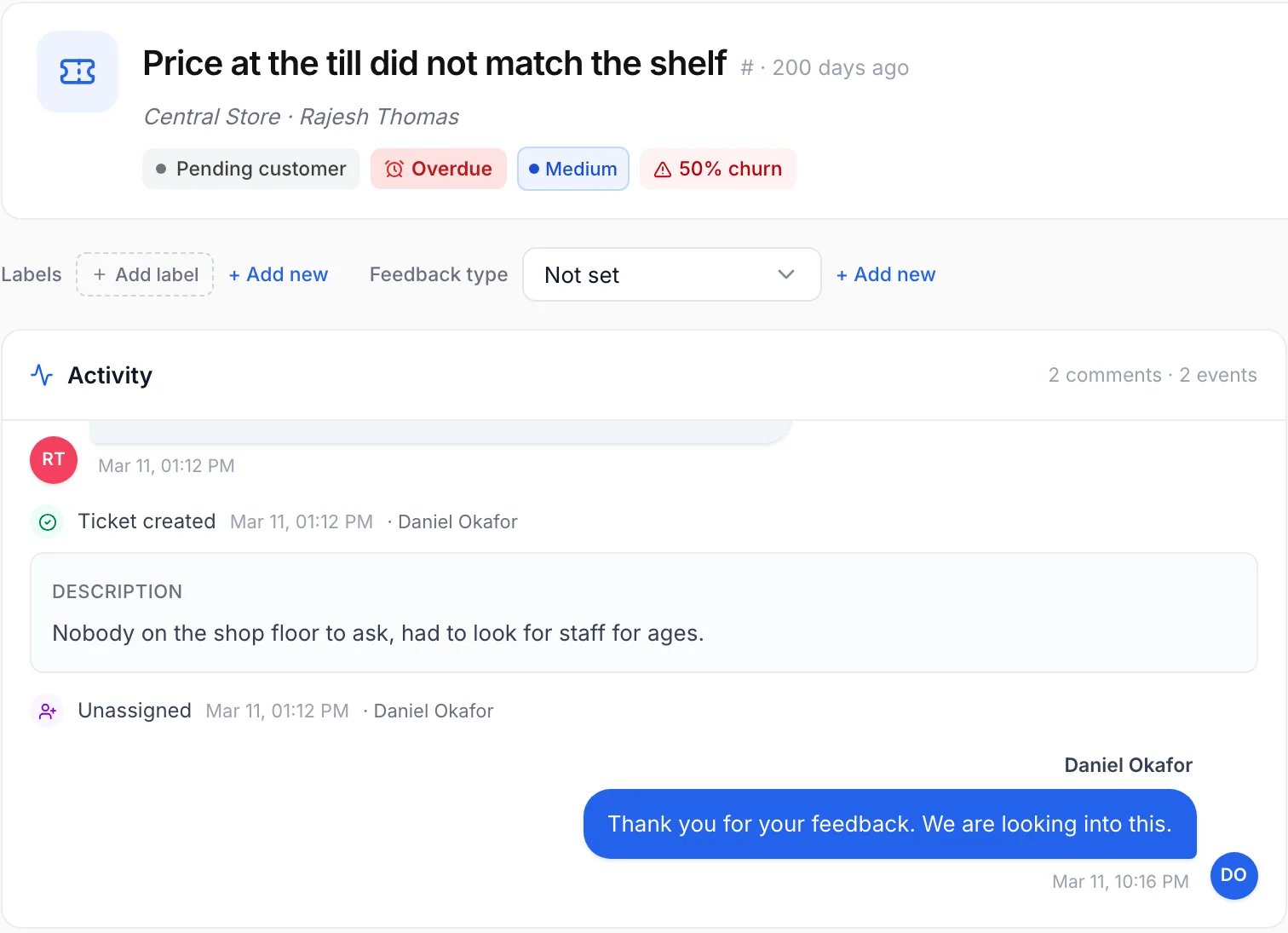
In Qmeter, ticket generation rules can trigger on NPS answers in the detractor range (or on smiley and star ratings, or keywords), assign the ticket by branch or service, and escalate it automatically if the first-response or resolution SLA is breached. See feedback ticketing.
Example: detractor recovery at a bank branch
Example: a customer scores 3 on an exit kiosk at a bank branch and writes “waited 40 minutes to change an address”. The branch manager receives an alert, the ticket appears in the “Needs your attention” list, and the customer — who entered a phone number on the kiosk — gets a call the same afternoon. The address change is completed by phone and the manager logs the root cause as “single counter for service requests at lunchtime”. After the same cause appears on several tickets, the branch adds a second counter for that hour.
What to look for in detractor comments
The follow-up comment is where a detractor response becomes actionable. When reading or classifying detractor comments, sort them into a few stable groups:
- Process — waiting, queues, paperwork, transfers between departments.
- People — courtesy, competence, a specific interaction.
- Product or service — what was delivered did not meet the need.
- Price or policy — fees, rules, terms the front line cannot change.
Also look for urgency signals: mentions of leaving, of a competitor, of safety, or of a repeated problem (“again”, “third time”). These deserve the highest priority. Text analytics and sentiment analysis can tag these patterns automatically across thousands of comments, but someone still needs to read the urgent ones.
Common mistakes with detractors
- Reporting the NPS without reading detractor comments. The score says how many; the comments say why.
- Treating 5s and 6s as “neutral”. They are detractors in the NPS method and often the easiest to recover.
- Arguing with the customer. The follow-up is for understanding and fixing, not defending the score.
- Asking staff to “manage” scores. Pressuring customers to rate 9 or 10 corrupts the data and hides real problems.
- Fixing cases but not causes. If the same complaint keeps appearing, the outer loop is missing.
Frequently asked questions
What score is a detractor in NPS?
A detractor is any respondent who answers 0, 1, 2, 3, 4, 5 or 6 on the 0–10 Net Promoter Score question about how likely they are to recommend the company.
Why is 6 a detractor in NPS?
The NPS method treats anything below 7 as a sign the customer is not loyal enough to recommend you and may leave or speak negatively. A 6 often signals disappointment rather than anger, which makes these customers worth contacting.
How do you convert a detractor into a promoter?
Respond quickly, fix the specific issue the customer raised, tell them what you changed and fix the underlying cause. Fast, personal service recovery can leave a customer more loyal than before the problem.
Can you have a positive NPS with detractors?
Yes. NPS is positive whenever the share of promoters is larger than the share of detractors. Almost every business has some detractors; the aim is to understand and reduce them.
Measure it at every location — live in one day
Feedback kiosks, QR and web surveys, SMS and email, real-time alerts and follow-up tickets in one platform. 14-day free trial.
✓ 15 minutes · ✓ No commitment · ✓ A real CX person