First contact resolution (FCR)
✓ Cloud or on-premise · ✓ Kiosk, QR, SMS, email and web · ✓ Live in one day
First contact resolution (FCR) is the percentage of customer issues resolved in the first interaction, with no follow-up, transfer or repeat contact needed. Formula: issues resolved on first contact ÷ total issues × 100. It is one of the strongest operational drivers of satisfaction, because every repeat contact adds effort and frustration for the customer.
What first contact resolution means
A customer brings a problem — a wrong charge, a lost card, a booking change, a complaint — through any channel: a phone call, a branch counter, an email, a chat. If the problem is solved in that interaction, it counts towards FCR. If the customer must call back, visit again, wait for someone to “get back to them” or be transferred to another team, it does not.
In contact centres the metric is often called first call resolution. “Contact” is the broader term and the better one for multi-channel organisations, where an issue might start in a branch and continue by phone.
FCR matters because effort is what customers remember about service. Being asked to repeat a story, chase an update or come back another day is a strong source of dissatisfaction — and repeat contacts cost the organisation twice.
FCR formula and worked example
FCR = (issues resolved on first contact ÷ total issues) × 100
Example: a service desk handles 1,000 issues in a month. 620 are resolved in the first interaction, 300 need a follow-up and 80 are escalated to another team. FCR = 620 ÷ 1,000 × 100 = 62%.
The hard part is deciding what “resolved” means. Three common ways to measure it:
| Method | How it works | Strength / weakness |
|---|---|---|
| Agent-reported | The agent marks the issue resolved at the end of the contact | Easy; tends to overstate FCR |
| Repeat-contact window | Resolved if the same customer does not contact again about the same issue within a set window (for example 7 days) | Objective; needs customer identification |
| Customer-reported | A post-contact survey asks “Was your issue resolved?” | Reflects the customer’s view; depends on response rate |
The most credible programs combine the repeat-contact window with the customer’s own answer.
How to improve first contact resolution
- Find the repeat-contact reasons. Classify issues by type and root cause; a handful of issue types usually generate most follow-ups.
- Give front-line staff authority to fix common problems — refunds below a threshold, rebookings, replacements — without approval chains.
- Fix the knowledge gaps behind transfers: if one question always goes to a specialist, train the first line or write the answer down.
- Route correctly from the start so the customer reaches the person who can solve the problem.
- Ask the customer. A one-question survey after the contact (“Was your issue resolved today?”) plus a CES question shows FCR from the customer’s side.
- Track the fix rate of escalations, not just their number.
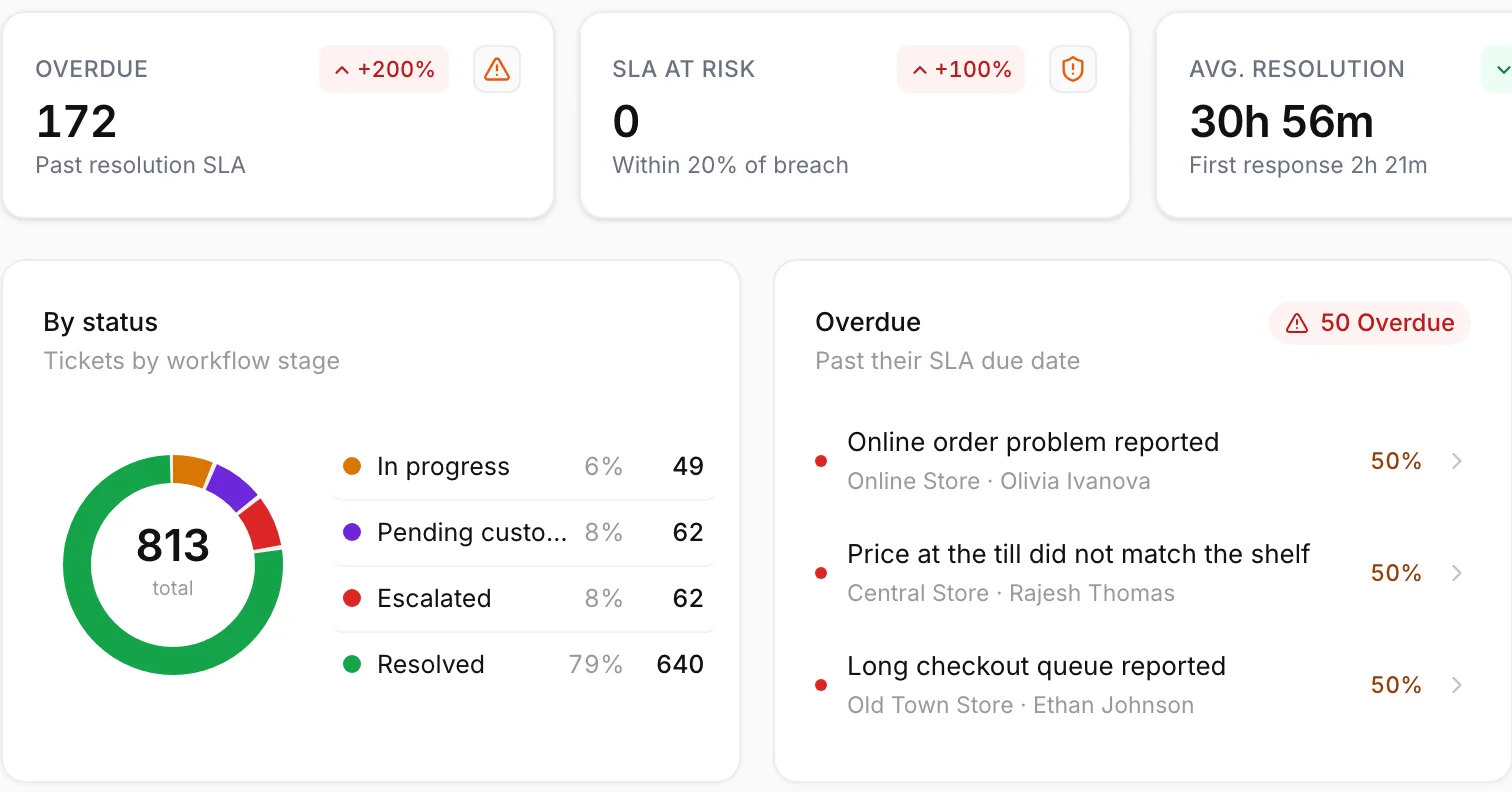
In Qmeter, a short survey after a service interaction can ask both questions, and tickets for unresolved issues carry first-response and resolution SLAs, escalation levels and a classification of labels, root causes and actions. The ticketing dashboard breaks volumes down by driver and root cause, which shows which issue types keep coming back. See feedback ticketing.
Example
Example: a utility’s customer-reported FCR (from a post-contact SMS question) is far below its agent-reported FCR. Classifying the unresolved contacts shows that most concern billing corrections that front-line staff cannot approve. The utility lets first-line staff approve corrections up to a set limit. Repeat contacts for billing fall, customer-reported FCR rises and the CES score for billing contacts improves — three views of the same change.
FCR and related service metrics
FCR is most useful when read alongside the metrics around it:
- First response time — how long the customer waited for the first meaningful reply.
- Resolution time — how long it took to fix issues that were not resolved first time.
- Reopen rate — how many “resolved” issues came back; a high rate means FCR is overstated.
- Customer Effort Score (CES) — how easy the customer found it to get the issue resolved.
- Transfer rate — how often the first contact had to hand the customer on.
Improving one at the expense of the others is a common trap. Pushing for short handling times can lower FCR; pushing FCR at any cost can lengthen handling times. Track them together.
Common mistakes
- Relying only on agent-reported FCR, which measures intention rather than outcome.
- Rewarding speed over resolution. Short handling times can push problems into repeat contacts.
- Ignoring cross-channel repeats — a customer who calls, then visits the branch about the same issue.
- Counting escalations as resolved because they left the first agent’s queue.
Frequently asked questions
How do you calculate first contact resolution?
Divide the number of issues resolved in the first interaction by the total number of issues handled in the period, then multiply by 100. Define “resolved” clearly, for example as no repeat contact about the same issue within 7 days.
What is the difference between first contact and first call resolution?
First call resolution refers to phone contacts. First contact resolution covers every channel — phone, branch, email, chat — and is the better metric for organisations where customers switch between channels.
Why does first contact resolution matter?
Every repeat contact adds effort and frustration for the customer and cost for the organisation. Resolving issues the first time is one of the most reliable ways to raise satisfaction and lower service costs.
How do you measure FCR from the customer’s side?
Ask a short question after the interaction, such as “Was your issue resolved today?”, and compare the answers with internal records of repeat contacts about the same issue.
Measure it at every location — live in one day
Feedback kiosks, QR and web surveys, SMS and email, real-time alerts and follow-up tickets in one platform. 14-day free trial.
✓ 15 minutes · ✓ No commitment · ✓ A real CX person