CBAHI patient satisfaction requirements: what accreditation and the MOH patient experience programme expect
✓ Cloud or on-premise · ✓ Kiosk, QR, SMS, email and web · ✓ Live in one day
In Saudi Arabia two systems shape how a hospital measures patient satisfaction. The Saudi Central Board for Accreditation of Healthcare Institutions (CBAHI) accredits hospitals against national standards that include Patient and Family Rights, Patient and Family Education and Quality Management and Patient Safety chapters, and its surveyors interview patients and families. The Ministry of Health runs the Patient Experience Measurement Program (PXMP), a national survey across hospitals, specialised centres, primary health care centres and other services, administered by an independent third party and reported as national benchmarks. A hospital needs its own continuous measurement to act between those external checks; this guide shows what to collect and how to hold the evidence.
Two systems, two different questions
They are easy to confuse, and they ask for different things:
| CBAHI accreditation | MOH Patient Experience Measurement Program | |
|---|---|---|
| Who runs it | Saudi Central Board for Accreditation of Healthcare Institutions | Ministry of Health, with an independent third party administering the surveys |
| What it looks at | Whether the hospital runs the required processes: patient rights, education, complaints, quality management | How patients rate their experience, by facility and service, against a national standard |
| How it is assessed | On-site survey: documents, interviews with leadership, staff, patients and families | Surveys designed per visit type; periodic national reports and benchmarks |
| What the hospital controls | The processes and the evidence | The experience itself, every day, in every unit |
The PXMP tells a hospital where it stands after the fact. CBAHI asks whether the hospital has a way of knowing and acting on its own. Continuous in-house measurement serves both.
Qmeter is not affiliated with CBAHI or the Ministry of Health and is not part of the PXMP.
What the CBAHI standards expect around patients' views
The national hospital standards describe processes, not a survey format. The chapters that touch patient experience are:
- Patient and Family Rights: patients are informed of their rights and responsibilities, including how to raise a concern; the hospital has a process to receive and respond to complaints.
- Patient and Family Education: communication in a language the patient understands, which in the Kingdom means Arabic first and English alongside.
- Quality Management and Patient Safety: the hospital measures, analyses and improves; patient feedback is one of the inputs leadership reviews.
Read the standards and their measurable elements in the edition your hospital is surveyed against; this page describes the pattern, not the clause text.
What the MOH Patient Experience Measurement Program measures
The Ministry of Health describes the programme as a national transformation initiative that lets patients and families take part in quality improvement by measuring their satisfaction with surveys designed for each visit type. It covers hospitals, specialised centres, primary health care centres, blood banks, tobacco cessation and premarital screening centres, the 937 service centre and other visits, and is intended to extend to all MOH facilities. An independent third party administers the surveys and issues the reports so that results are comparable across facilities; outputs include a national standard for patient experience, comparison across facilities, regional and international benchmarking and the drivers of experience at facility and service level.
For a hospital this means two things: the national result arrives as a benchmark it cannot change retrospectively, and the drivers behind the score are visible only to a hospital that measures the same moments itself, every day.
A patient satisfaction checklist for CBAHI preparation
The free tool above turns this list into a gap report you can e-mail to yourself.
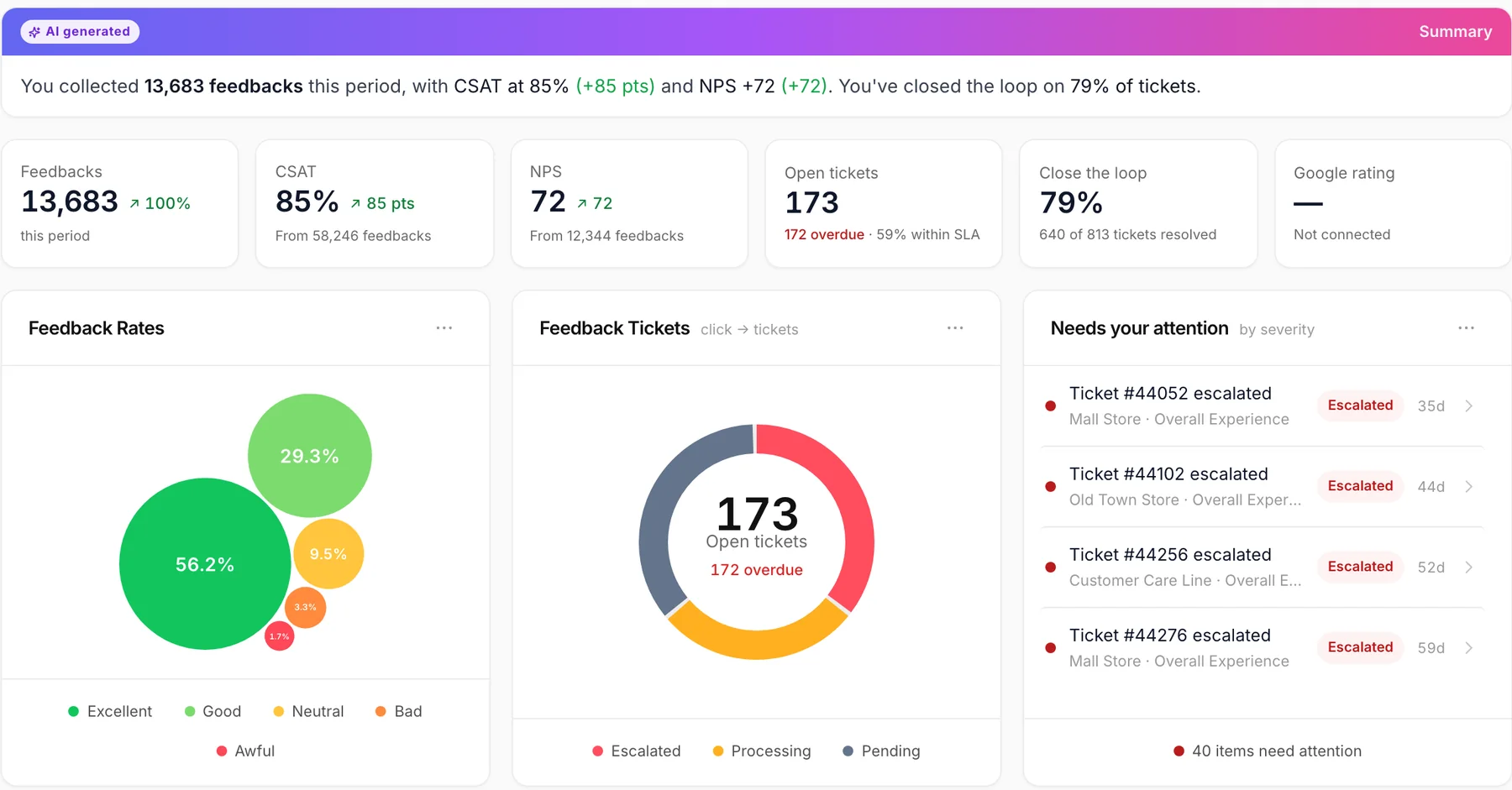
- Inform: patients know, in Arabic and English, how to give feedback and how to complain, at every unit.
- Collect at the moment: one question at outpatient exit, pharmacy, laboratory, emergency and discharge; SMS the same day for those who leave quickly.
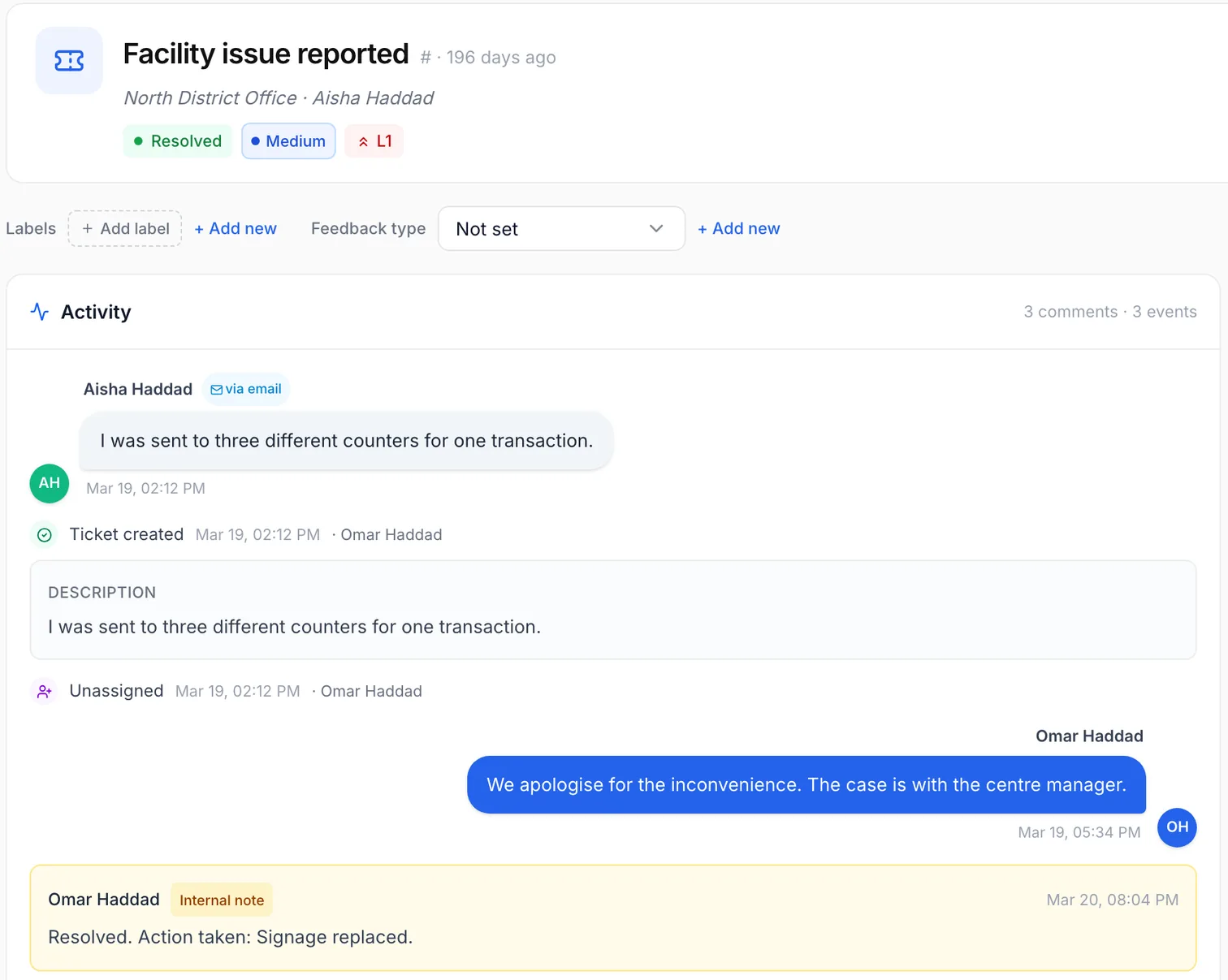
- Record complaints as cases: owner, deadline, escalation, outcome, audit trail.
- Analyse by unit and language: Arabic and English comments categorised; results by service, shift and period.
- Act and minute it: findings and decisions in the quality committee record.
- Protect the data: minimise, mask, retain under policy; keep it in the Kingdom if your policy requires.
Arabic first, English alongside
A survey a patient cannot read is not evidence of anything. In Saudi hospitals the first screen should be Arabic with a one-tap switch to English and, where the patient population needs it, Urdu or other languages. Right-to-left layout, Arabic comments and Arabic reports are part of the set-up, not an afterthought. The bilingual kiosk and QR flow is described on the Arabic and English patient kiosk page and the language mechanics on multilingual surveys.
Complaints as cases, not as a register
A surveyor who asks "show me how this complaint was handled" needs an answer in seconds. In Qmeter a low rating or a written complaint opens a case routed to the unit's owner with first-response and resolution deadlines; missed deadlines escalate; closing requires a root cause and an action; the patient can be informed by SMS. Every step is written to an audit trail. See closed-loop ticketing.
Keeping patient data in the Kingdom
Hospitals whose policy or regulator requires patient data to stay in Saudi Arabia can run Qmeter on their own infrastructure with the full product: on-premise deployment. In the cloud, personal data in comments is masked by default, revealed only with an audited action and removed by retention rules; see security and privacy.
Sources
- Ministry of Health: Patient Experience Measurement Program (purpose, facilities covered, third-party administration, outputs).
- CBAHI National Hospital Standards, 3rd edition (effective 1 January 2016) (chapter list including Patient and Family Rights, Patient and Family Education, Quality Management and Patient Safety).
- Promoting patients' rights through hospital accreditation (peer-reviewed overview).
Frequently asked questions
Does CBAHI require a patient satisfaction survey?
The national hospital standards describe processes: informing patients of their rights and how to complain, handling complaints, and measuring and improving quality with data that includes patients' views. Surveyors also interview patients and families on site. The survey format is the hospital's choice; the evidence that feedback is collected, reviewed and acted on is not optional. Check the measurable elements in the edition you are surveyed against.
What is the MOH Patient Experience Measurement Program?
A Ministry of Health programme that measures patient experience across MOH hospitals, specialised centres, primary health care centres, blood banks and other services with surveys designed per visit type. An independent third party administers the surveys and issues reports, and results are used as a national standard, for comparison between facilities and for benchmarking.
Do we still need our own measurement if the PXMP surveys our patients?
Yes. The national survey tells you where you stand; it does not tell you which unit, shift or step caused the score, and it cannot open a case for a patient who had a bad day. Your own continuous measurement does both, and it is what accreditation surveyors ask to see.
Can the survey run in Arabic and English on the same device?
Yes. The first screen is Arabic with a one-tap switch to English or other languages; layout is right-to-left for Arabic; comments and reports stay in the patient's language, with AI translation for the team.
Is Qmeter certified by CBAHI or the Ministry of Health?
No. CBAHI accredits hospitals, not software, and Qmeter is not affiliated with CBAHI or the Ministry of Health. Qmeter is a patient feedback platform that produces the continuous, traceable evidence a hospital's own accreditation process needs.
Can patient data stay inside Saudi Arabia?
Yes. Qmeter can be deployed entirely on the hospital's own infrastructure, so patient data never leaves it. Cloud deployment with PII masking, audit logs and retention rules is the default.
Measure it at every location — live in one day
Feedback kiosks, QR and web surveys, SMS and email, real-time alerts and follow-up tickets in one platform. 14-day free trial.
✓ 15 minutes · ✓ No commitment · ✓ A real CX person