JCI patient experience requirements: what accreditation expects from patient feedback and complaints
✓ Cloud or on-premise · ✓ Kiosk, QR, SMS, email and web · ✓ Live in one day
Joint Commission International (JCI) accredits hospitals against its Standards for Hospitals, now in the 8th edition, effective 1 January 2025. The standards are organised in sections, one of which is Patient-Centered Standards, with chapters such as Patient and Family Rights (PFR) and Quality Improvement and Patient Safety (QPS). In practice an accredited hospital needs a working process to hear patients, a documented way to receive and resolve complaints, and evidence that feedback feeds quality improvement. This guide turns that into a checklist and shows how to produce the evidence continuously rather than before a survey.
What JCI expects around patient experience
JCI does not prescribe a particular survey or a target score. Its standards describe processes a hospital must run and be able to show. Three areas touch patient experience directly:
- Patient and family rights. Patients are informed of their rights and of how to raise a concern; the hospital has a process to receive, investigate and respond to complaints and conflicts.
- Patient-centred care. Communication, education and respect for preferences are part of the standards, which means the patient's view of the care is relevant evidence.
- Quality improvement and patient safety. The hospital selects measures, collects data, analyses it and acts on it. Patient feedback is one of the data sources leadership is expected to use.
The exact standards, measurable elements and intent statements are in the edition of the manual your hospital is surveyed against. Check them there; this page describes the pattern, not the clause text.
Qmeter is not affiliated with Joint Commission International. JCI is a trademark of its owner.
The evidence a surveyor can actually review
During a survey, compliance is assessed through document review, staff and patient interviews and tracer activity. A patient feedback programme is credible to a surveyor when it can show:
- Continuity: feedback collected every day at defined points of care, not a one-off survey done the month before the visit.
- Traceability: every rating and comment tied to a unit, a service and a time.
- A closed loop: a low rating or a complaint becomes a case with an owner, a deadline and a documented resolution.
- Use in improvement: minutes, dashboards or reports that show leadership looked at the results and changed something.
A patient feedback checklist for JCI preparation
Use this as the backbone of your programme. The free tool above turns it into a gap report you can e-mail to yourself.
| Area | What to have in place | Evidence |
|---|---|---|
| Information to patients | Patients are told, in their language, how to give feedback and how to complain | Signage, admission pack, kiosk or QR at every unit |
| Collection | A short question at discharge, outpatient exit, emergency, pharmacy and lab; SMS after the visit for those who leave quickly | Response log by unit and day |
| Complaints | Every complaint recorded as a case with owner, deadline, escalation and outcome | Case register with audit trail |
| Analysis | Results by unit, service, shift and language; comments categorised | Monthly report to the quality committee |
| Action | Decisions recorded against findings; patient informed of the outcome where appropriate | Committee minutes, closed cases |
| Privacy | Personal data minimised, masked and retained under policy | Access log, retention rule |
Where and how to collect feedback in a hospital
One channel never reaches every patient. A programme that holds up in a tracer uses the moment that fits each setting:
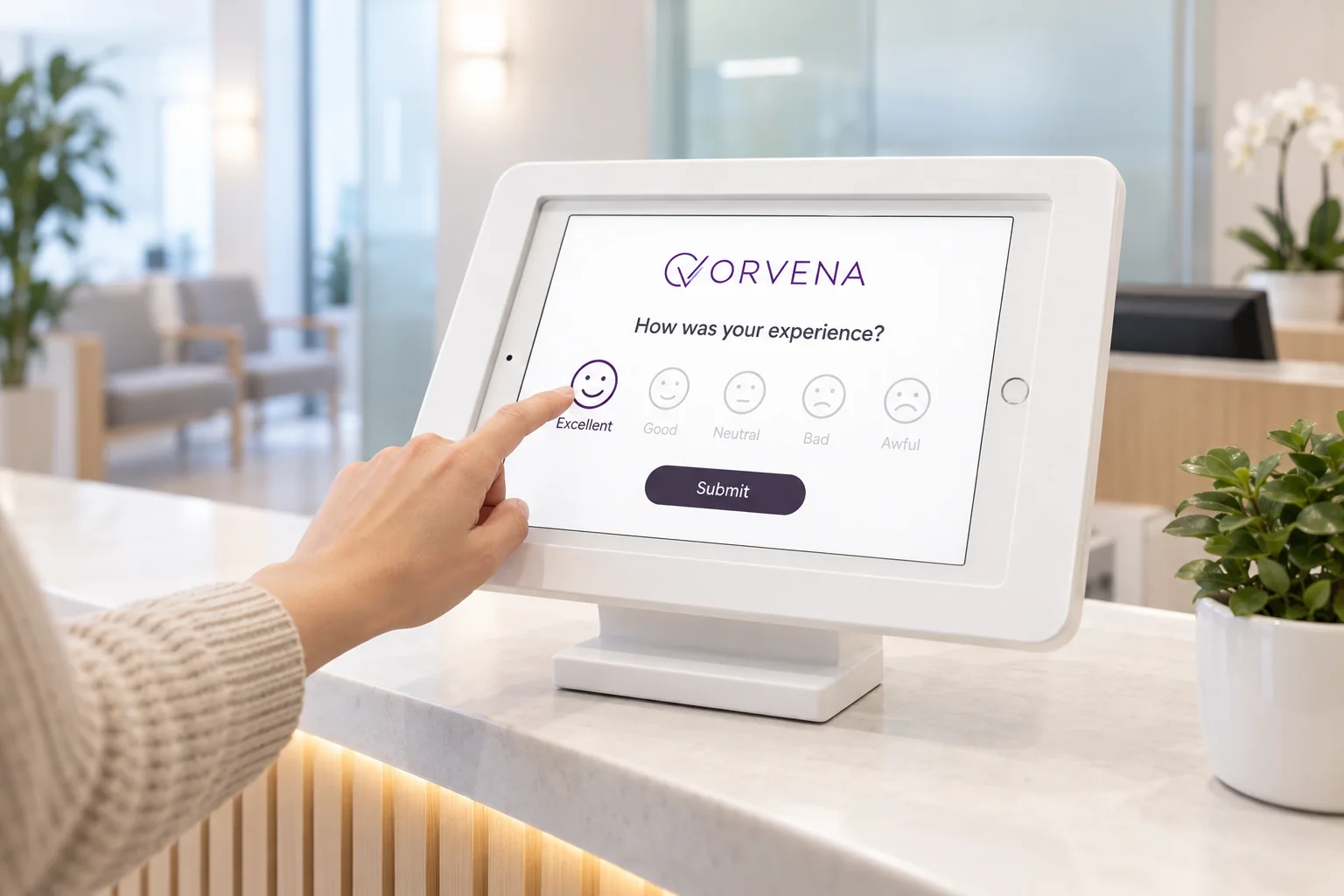
- Outpatient and pharmacy exit: a feedback kiosk or tablet with one question in Arabic and English; a follow-up only when the rating is low.
- Wards and discharge: a QR code on the bedside card or discharge letter, so the patient or family answers on their own phone.
- After the visit: an SMS or e-mail survey the same day through campaigns, for patients who did not stop at the exit.
- Emergency and waiting areas: a wall-mounted screen or QR point, because nobody fills in a form while waiting.
All channels run on the same survey template, so a unit's score is comparable whichever way the patient answered. The Arabic and English bilingual set-up is described on the bilingual patient kiosk page.
Turning a complaint into a documented case
Accreditation surveyors ask how a complaint travels through the hospital. A paper register or a shared mailbox cannot answer that question reliably; a case workflow can.
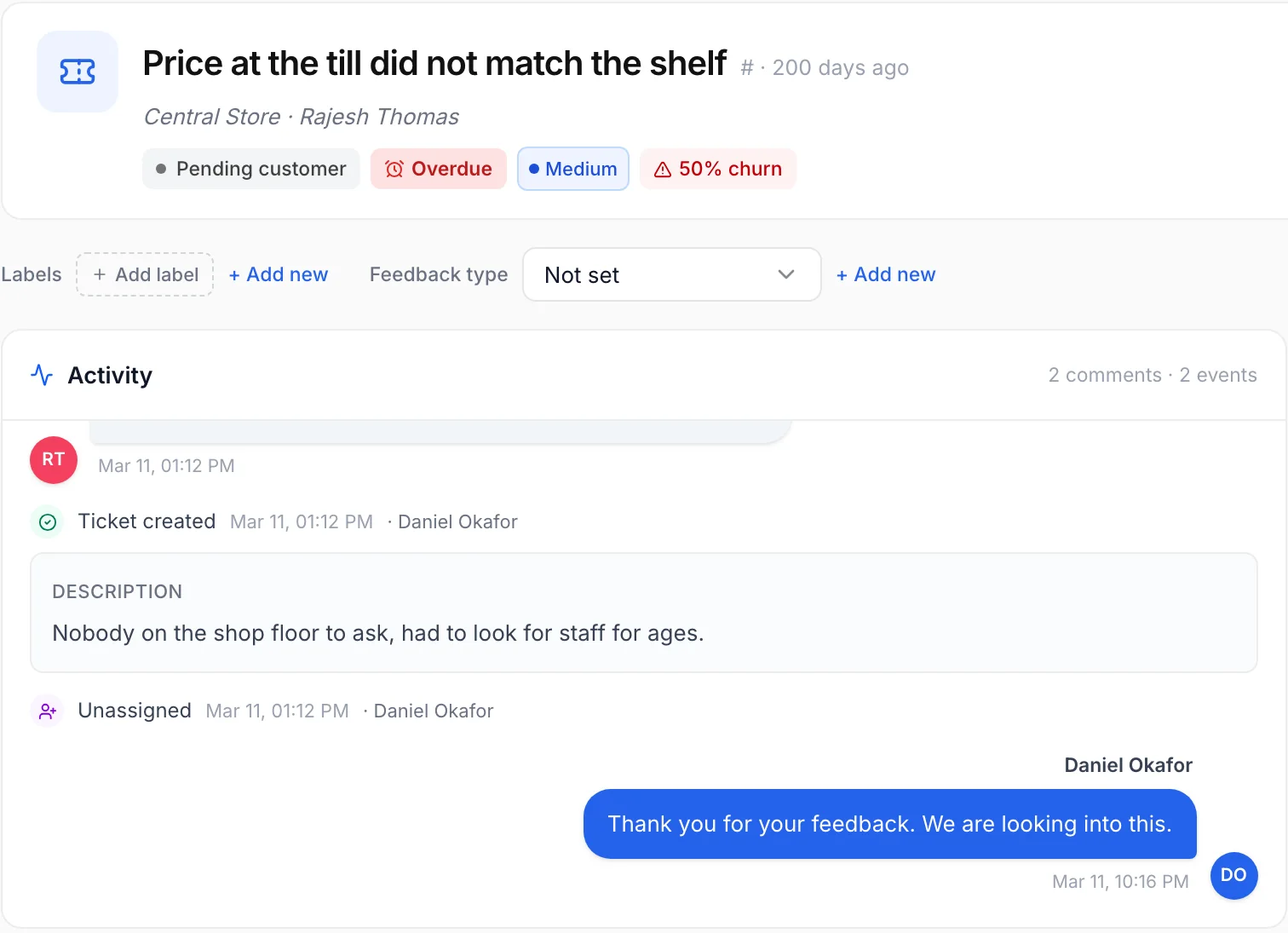
In Qmeter a low rating or a written complaint opens a case automatically, routed to the unit's owner with first-response and resolution deadlines. Missed deadlines escalate. Closing requires a root cause and the action taken, and the patient can be told the outcome by SMS or e-mail. The mechanics are on the closed-loop ticketing page.
Reporting that fits the quality committee
Quality committees meet on a calendar; the feedback report should arrive on the same calendar without anyone compiling it by hand. Scheduled reports by unit, service and period, comment categories, and the status of open cases are what a committee needs to show that feedback was reviewed and acted on. Dashboards are described on the analytics page.
Data protection matters in the same review: personal data in comments is masked by default and revealed only with an audited action, and retention rules remove it on schedule. See security and privacy. Hospitals whose policy keeps patient data inside the country can run the platform on their own infrastructure: on-premise deployment.
Sources
- Joint Commission International Standards for Hospitals, 8th edition (effective 1 January 2025; sections include Patient-Centered Standards).
- JCI Accreditation Standards for Ambulatory Care, 4th edition (standards only) (Patient and Family Rights chapter structure).
- Promoting patients' rights through hospital accreditation (peer-reviewed overview of how accreditation chapters on patient rights work).
Frequently asked questions
Does JCI require a patient satisfaction survey?
JCI standards describe processes rather than a named survey: patients must be informed of their rights and of how to complain, complaints must be received and resolved through a defined process, and quality improvement must use data, which includes patient feedback. How you collect that feedback is your choice, but you must be able to show it is collected, reviewed and acted on. Check the measurable elements in the edition you are surveyed against.
Which JCI edition applies in 2026?
The Joint Commission International Standards for Hospitals, 8th edition, effective 1 January 2025. Hospitals surveyed from that date are assessed against it.
What evidence do surveyors look for on complaints?
That patients know how to complain, that each complaint is recorded, investigated and answered within a defined time, and that the hospital can show what happened in individual cases. A case register with owner, dates, actions and outcome, plus an audit trail, answers all of those questions.
Can a kiosk at the exit count as patient feedback for accreditation?
Yes, as one channel of a documented programme. The value for a surveyor is continuity and traceability: every answer tied to a unit and a time, low ratings handled as cases, results reviewed by the quality committee. A kiosk alone, with nobody reading the results, is not a programme.
Is Qmeter certified or endorsed by JCI?
No. JCI does not certify software and Qmeter is not affiliated with Joint Commission International. Qmeter is a patient feedback platform that produces the continuous, traceable evidence a hospital's own accreditation process needs.
Can patient feedback data stay inside our country?
Yes. Qmeter can run on your own infrastructure, with the full product, so patient data never leaves your network. Cloud deployment with PII masking, audit logs and retention rules is the default option.
Measure it at every location — live in one day
Feedback kiosks, QR and web surveys, SMS and email, real-time alerts and follow-up tickets in one platform. 14-day free trial.
✓ 15 minutes · ✓ No commitment · ✓ A real CX person