Voice of the Customer (VoC)
✓ Cloud or on-premise · ✓ Kiosk, QR, SMS, email and web · ✓ Live in one day
Voice of the customer (VoC) is everything customers tell a business — survey answers, complaints, reviews, support conversations and comments — collected across channels and analysed together as one body of evidence. A VoC program is judged on two things: whether it hears customers wherever they are, and whether what they say changes anything.
What voice of the customer means
The phrase comes from product development. It was popularised by Abbie Griffin and John Hauser’s 1993 paper The Voice of the Customer in Marketing Science, which described how to capture customer needs in their own words before translating them into product requirements. Today the term is used more broadly: VoC is the continuous practice of listening to customers and turning what they say into decisions about service, product and operations.
Three ideas separate a VoC program from an occasional survey:
- Customers’ own words matter as much as scores. A rating says where the experience is weak; the comment says what is wrong.
- Every channel counts. A complaint at a branch counter, a one-star review and a low survey score about the same problem are one signal, not three.
- Listening is only half the job. VoC exists to drive action — fixing a process, recovering an unhappy customer, changing a product.
VoC is often confused with customer experience management (CXM). The difference is scope: VoC is the listening and understanding part; CXM is the wider discipline that also owns the operational changes. In practice the two blend, and most teams use “VoC program” to mean the whole loop from collection to action.
Where VoC data comes from
No single source gives an honest picture, because each one hears a different group of customers. A well-built VoC program combines several and keeps their biases in mind:
| Source | What it tells you | Built-in bias |
|---|---|---|
| Transactional surveys (after a visit, purchase or call) | How one specific interaction went | Only hears customers who were invited and chose to answer |
| Relationship surveys (NPS, a few times a year) | Overall loyalty and trend | Memory-based; weak on operational detail |
| On-site kiosks and QR codes | Walk-in customers at the moment of service | Over-represents people with time to stop |
| Complaints and support tickets | What broke badly enough to escalate | Hears the blocked and the angry, not the quietly dissatisfied |
| Public reviews | What prospects will read | Skews to extremes — delight or anger |
| Front-line staff notes, call logs | Context surveys never capture | Filtered through the employee |
Combining sources is what makes VoC reliable. If kiosk scores, complaint themes and review text all point at the same queue at the same branch, you are no longer looking at an anecdote. Our guide to omnichannel feedback collection covers how to choose channels per touchpoint.
How a voice of the customer program works
- Collect at the touchpoints that decide the experience — exit kiosks, QR codes on receipts, SMS or email after a service, a widget on the website.
- Unify every response in one place, tagged with branch, service, channel and time, so a kiosk score and an emailed complaint about the same visit sit side by side.
- Analyse scores and open text together. Text analytics and AI summarisation group thousands of comments into themes with volumes and sentiment attached.
- Act on two levels: individual (a ticket and a call-back for an unhappy customer — see closed-loop feedback) and structural (fix the process that produced the complaint).
- Verify that the change moved the numbers at the location where it was made.
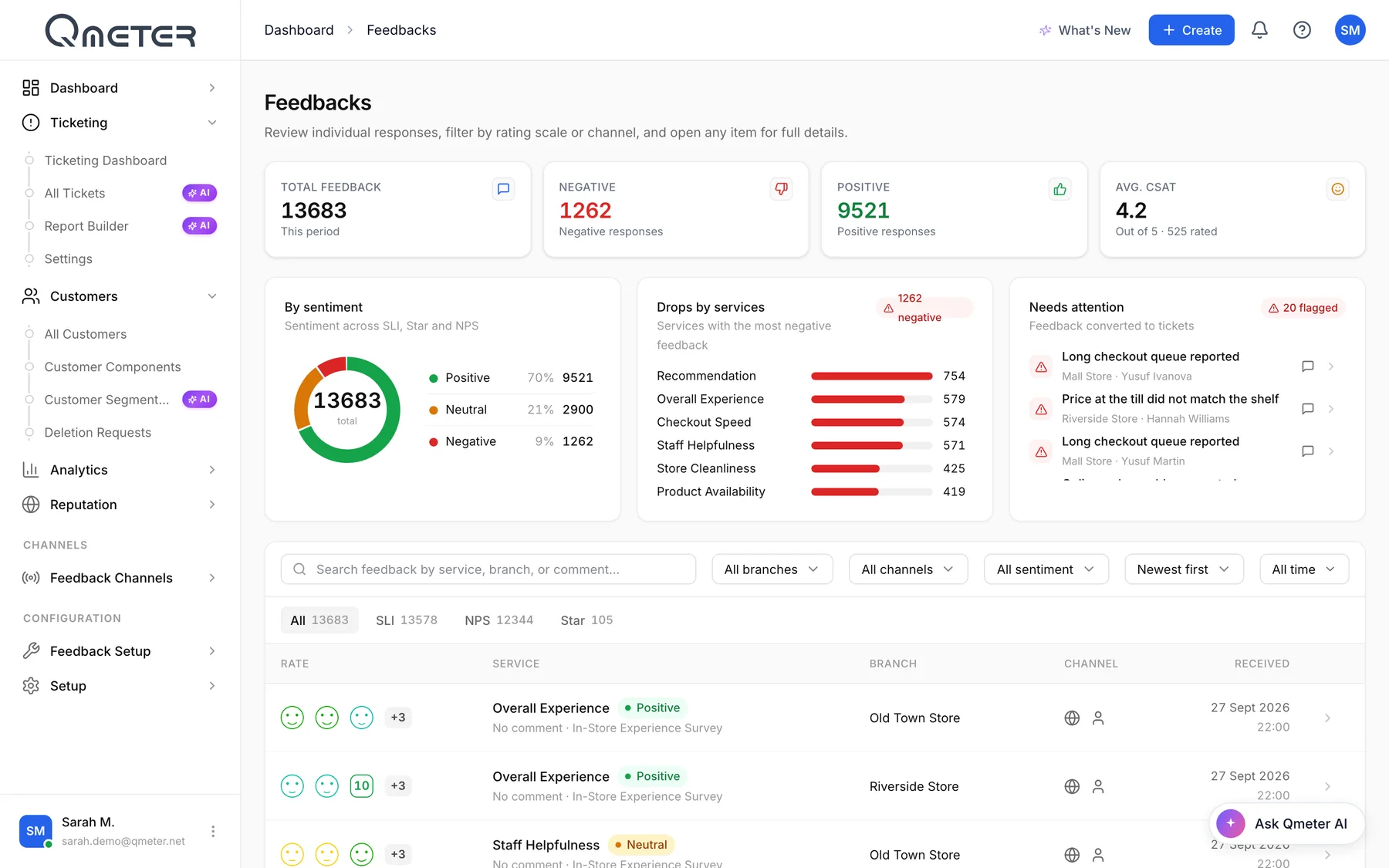
Example: VoC at a 40-branch retailer
Example: a retailer with 40 stores collects feedback through exit tablets, QR codes on receipts and an email survey after online orders. In one month it receives around 6,000 responses. Scores are stable overall, but the text analysis shows a growing theme — “only one till open” — concentrated in six stores on weekday evenings.
Three things happen. Negative responses mentioning queues open tickets for the six store managers, who call back customers who left contact details. The operations team moves one staff shift later in those stores. Four weeks later, the queue theme falls in those six stores and their satisfaction scores recover, while the other 34 stores — where nothing changed — stay flat. That comparison is the evidence the change worked, and it only exists because every response carried a store and a time.
How to measure and improve a VoC program
Measure the program itself, not just the customer scores it produces:
- Coverage — which journeys and locations produce feedback, and which are silent. Gaps are usually physical locations without a kiosk or QR code.
- Response rate per channel — a falling rate is an early sign of survey fatigue or a broken device.
- Headline metrics — NPS, CSAT or an overall index such as Qmeter’s SLI, tracked per branch and service rather than as one company number. See NPS vs CSAT vs CES.
- Close-the-loop rate — the share of negative responses that received a reply.
- Time to action — from complaint to first response, and from theme detected to process changed.
To improve a program, start where it breaks. Collection without analysis creates a data graveyard; analysis without action creates report culture; action without re-measurement means nobody knows what worked.
Common VoC mistakes
- Relying on one channel. An email-only program never hears walk-in customers; a review-only program hears only extremes.
- Reporting averages. A company-wide score hides the three branches that are failing.
- Ignoring open text. Scores without comments tell you where, not why.
- No owner for action. If nobody is assigned to respond, feedback becomes a monthly slide.
- Surveying too often. Long, frequent surveys lower both the response rate and the quality of answers.
Qmeter collects VoC from kiosks (online and offline), QR codes, SMS and email campaigns, web links and widgets, and manually entered feedback such as phone calls or a complaint box, in more than 100 languages. Negative responses can open tickets automatically, and the report builder and AI Analyst summarise trends by branch. For the full program design, read the Voice of the Customer guide.
Frequently asked questions
What is voice of the customer in simple terms?
Voice of the customer (VoC) is everything customers say about a business — survey answers, complaints, reviews and comments — collected from every channel and analysed together so the business can decide what to fix or improve.
What is the difference between VoC and customer feedback?
Customer feedback is a single input, such as one survey response or one complaint. Voice of the customer is the combined, analysed picture of all those inputs across channels, plus the process that turns them into action.
What are examples of VoC data?
Common examples are post-visit CSAT surveys, NPS relationship surveys, kiosk and QR feedback at physical locations, complaint records, support tickets, public reviews, call notes and comments from front-line staff.
Which metrics are used in a VoC program?
Most programs track NPS for loyalty, CSAT or CES for individual interactions, response rate per channel, the share of negative responses that received a reply, and the time from complaint to first response.
How often should VoC be collected?
Transactional feedback should be collected continuously at key touchpoints; relationship surveys such as NPS are usually run two to four times a year. Suppression rules should stop the same customer from being asked too often.
Measure it at every location — live in one day
Feedback kiosks, QR and web surveys, SMS and email, real-time alerts and follow-up tickets in one platform. 14-day free trial.
✓ 15 minutes · ✓ No commitment · ✓ A real CX person