Patient satisfaction survey: what to measure, what to ask and how to act
✓ Cloud or on-premise · ✓ Kiosk, QR, SMS, email and web · ✓ Live in one day
A patient satisfaction survey asks patients to rate their experience of care — access, waiting, communication, cleanliness, discharge and overall satisfaction — so a clinic or hospital can see where the experience breaks and fix it. The most useful surveys are short, asked at or right after the visit, and routed to someone who can act.
What a patient satisfaction survey is — and what it is not
Clinical quality is measured rigorously through outcomes, safety indicators and audits. The experience around the care is measured far less often, even though patients judge a provider largely by it: how easy it was to book, how long they waited, whether staff explained things, whether the room was clean, whether they knew what to do after leaving.
A patient satisfaction survey captures that layer. Two related terms are worth separating:
- Patient satisfaction — how patients evaluate their experience (“How satisfied were you with…?”). It depends on expectations as well as on what happened.
- Patient experience — what patients report actually happened (“Did a nurse explain your medication?”). It is more objective and easier to act on.
Good questionnaires use both: a few satisfaction ratings for the trend, and specific experience questions to show what to fix. Neither replaces clinical quality measurement; they describe a different, equally real part of care.
What to measure in a patient satisfaction survey
Pick the domains that match your setting. An outpatient clinic, an inpatient ward and a dental chain will not ask the same questions, but most surveys draw from this list:
| Domain | What it covers | Typical setting |
|---|---|---|
| Access and booking | Ease of getting an appointment, phone and online booking | Outpatient, dental, diagnostics |
| Arrival and registration | Reception courtesy, paperwork, signage and wayfinding | All |
| Waiting time | Time in the waiting room, being kept informed about delays | Outpatient, emergency, labs |
| Communication with doctors | Listening, explaining clearly, time given to questions | All |
| Communication with nurses | Responsiveness, explanations, help when needed | Inpatient, day surgery |
| Respect, dignity and privacy | Being treated with courtesy, privacy during examination | All |
| Environment | Cleanliness of rooms and washrooms, quiet at night, food | Inpatient, clinics |
| Pain and comfort | Whether staff did everything they could to help with pain | Inpatient, surgery |
| Discharge and next steps | Medication explained, written instructions, who to call | Inpatient, day surgery, emergency |
| Billing and administration | Clarity of costs, insurance handling, invoices | Private healthcare |
| Overall | Overall satisfaction and likelihood to recommend | All |
Waiting and communication are, in many settings, the domains patients comment on most — and the ones that sit between departments, so nobody owns them until the data assigns them an owner.
Patient satisfaction survey questions: examples
Short post-visit survey (outpatient, under a minute):
- Overall, how satisfied were you with your visit today? (five smileys)
- How would you rate the waiting time before your appointment? (five smileys)
- Did the doctor explain things in a way you could understand? (Yes, completely / Yes, partly / No)
- How likely are you to recommend our clinic to friends and family? (0–10)
- Is there anything we could have done better? (optional comment)
Inpatient or discharge survey (a few minutes):
- How often did nurses explain things in a way you could understand?
- When you needed help, how quickly did you get it?
- How clean was your room and bathroom?
- How quiet was the area around your room at night?
- Before you left, did someone explain what each new medicine was for?
- Did you receive written information about what to do after discharge?
- Overall, how would you rate this hospital? (0–10)
Follow-up questions appear only when relevant — for example, “What went wrong?” after a low score, or a question about the wait only for patients who report waiting more than 30 minutes. For a ready-made questionnaire you can adapt, use our patient satisfaction survey template; for wording principles, see how to create effective surveys.
Channels: where and when to ask patients
The best channel is the one that reaches patients at the right moment with the least effort. Most providers combine several:
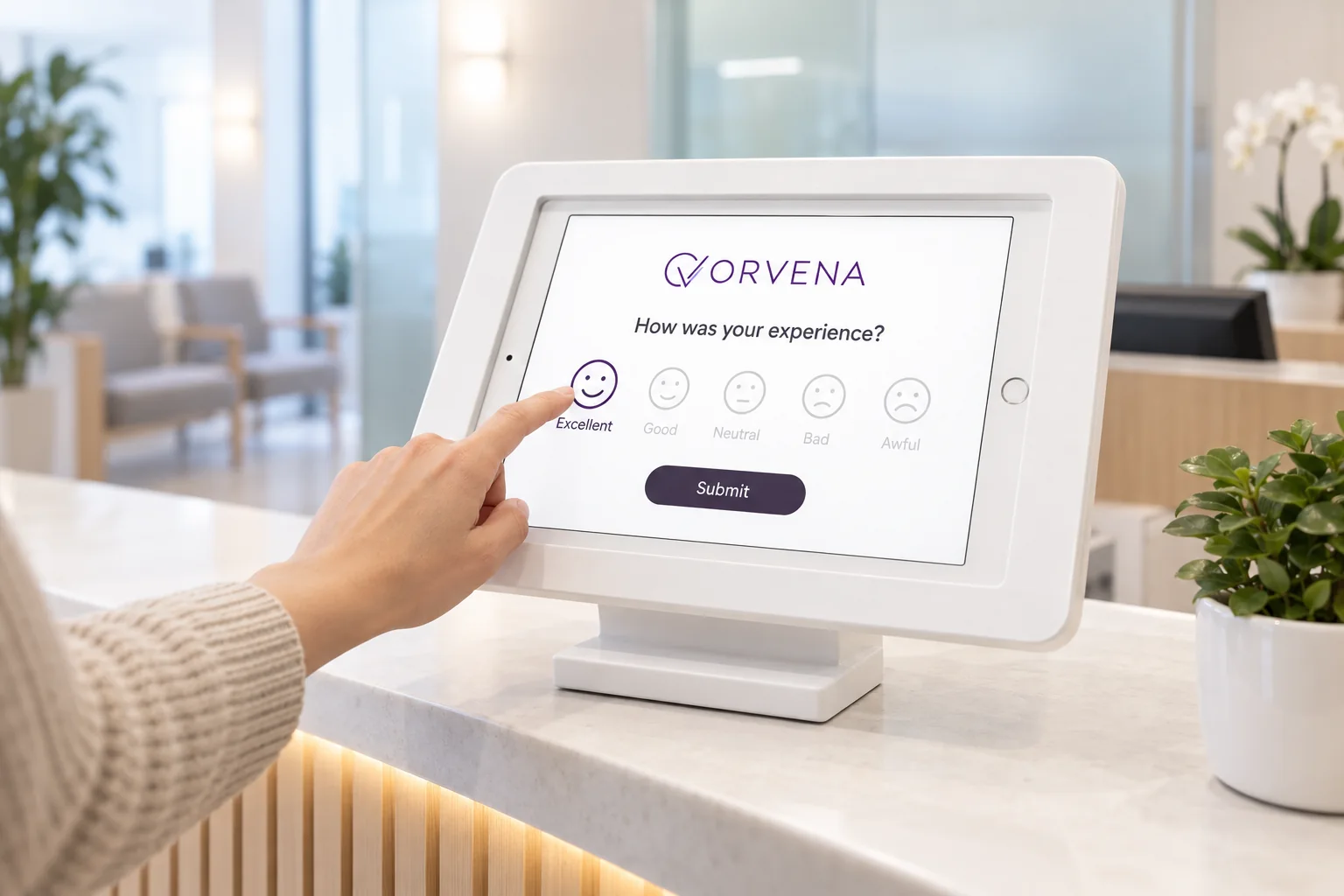
- Kiosk or tablet at the exit or reception — one-tap feedback as patients leave. It needs no contact details and can be anonymous, which lowers the barrier to honest answers. Kiosks keep working if the internet drops and sync later.
- Bedside tablet — for inpatients during the stay, so problems (noise, pain management, food) are raised while they can still be fixed for that patient.
- QR codes — at the bedside, in waiting areas, washrooms and on discharge paperwork, each tagged with the ward or department.
- SMS after the visit — a short link the same day, while the experience is fresh; suitable for outpatient, diagnostics and telehealth.
- Email after discharge — for longer inpatient surveys and relationship-level questions.
Two practical points: offer the survey in the languages your patients speak (Qmeter supports more than 100, with AI-assisted translation), and make it easy for family members or carers to answer on behalf of patients who cannot.
What is HCAHPS?
HCAHPS — the Hospital Consumer Assessment of Healthcare Providers and Systems — is a standardised survey of adult inpatients’ hospital experience used in the United States. It was developed by the Centers for Medicare & Medicaid Services (CMS) together with the Agency for Healthcare Research and Quality (AHRQ). Hospitals administer it through CMS-approved survey vendors or, if approved, themselves, following strict CMS protocols on sampling, timing and survey mode. Results are publicly reported on CMS’s Care Compare website and are used in Medicare’s Hospital Value-Based Purchasing program.
HCAHPS covers topics such as communication with nurses and doctors, responsiveness of hospital staff, communication about medicines, discharge information, cleanliness and quietness of the environment, an overall hospital rating on a 0–10 scale and willingness to recommend. Because it is standardised, it lets hospitals be compared with each other.
Its design also explains its limits for day-to-day management: it is sent after discharge to a sample of patients, so results arrive weeks later and cannot be traced back to a specific shift or used to help the patient who had the problem. That is why many hospitals also run their own real-time patient feedback alongside regulatory surveys. Qmeter is not an HCAHPS survey vendor and does not administer HCAHPS; it is used for this operational, real-time layer — kiosks, bedside and QR feedback, post-visit SMS and complaint follow-up.
Privacy and data protection
Patient feedback is sensitive even when it contains no clinical data. A survey platform for healthcare should keep personal information to a minimum and protect what it does hold. In Qmeter:
- Anonymous by default where you choose — kiosk and QR surveys need no name or contact details; contact fields are optional and only appear if you add them.
- PII masking — personal fields are masked in dashboards and reports; revealing them is permission-based and every reveal is logged.
- GDPR workflows — erasure requests are handled as tracked requests and anonymise personal data while keeping statistics intact.
- Retention window — records of inactive customers are anonymised automatically after the period you set.
- Branch-level access — staff see only the sites and departments assigned to them.
- AI with privacy — the AI Analyst sends only the report structure to the AI model, never patient answers or personal records.
- On-premise option — hospital groups that must keep data inside their own infrastructure can run Qmeter on-premise.
Qmeter is a feedback system, not a medical-records system: it holds only what patients choose to share. Health-data rules differ by country, so confirm your requirements with your data-protection or compliance team. Details are on security and GDPR.
Acting on patient feedback
A patient satisfaction survey that only produces a quarterly report changes little. The value comes from two loops:
- Respond to the individual patient. A low score or a worrying comment alerts the duty or department manager straight away and opens a ticket with an owner and a deadline. For inpatients, that can mean a problem is fixed before discharge; for outpatients, a call the same day.
- Fix the recurring cause. Each closed ticket records a root cause and the action taken, so patterns — registration queues on Monday mornings, unclear discharge instructions on one ward — become visible and fixable. See closed-loop feedback.
Share results with the teams who produce them. Positive comments that name a nurse or a receptionist are among the most motivating feedback staff receive; negative trends shown by department and shift are far easier to act on than a hospital-wide average.
Reading the results
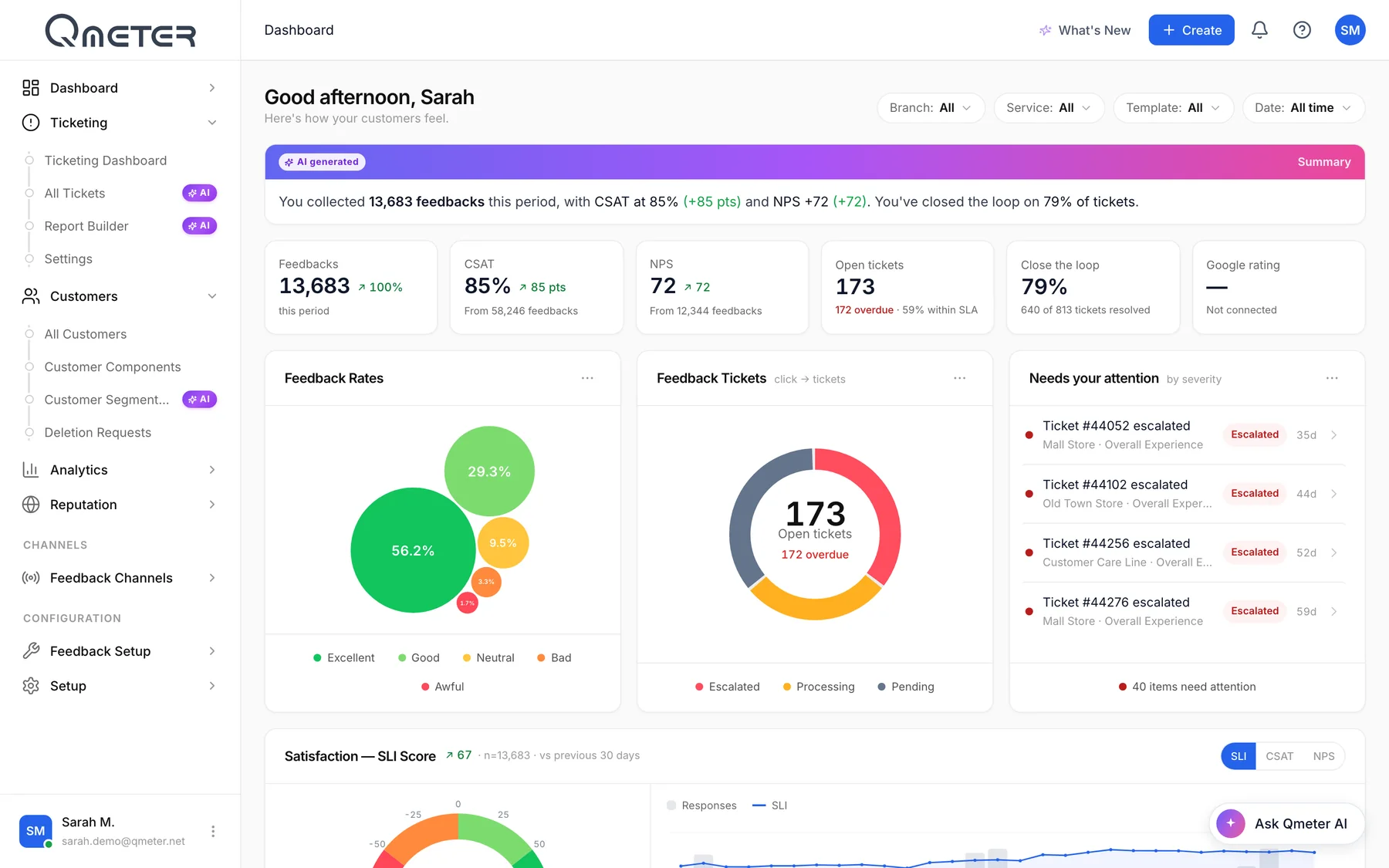
- Report by site, department and period, not as one hospital-wide number.
- Use consistent metrics: CSAT for individual visits, NPS for willingness to recommend, an effort question for booking and results, or Qmeter’s single SLI score to compare sites. See NPS vs CSAT vs CES.
- Watch the sample size. A department with 15 responses a month will swing; read trends over longer periods there.
- Track response rate per channel — a sudden fall usually means a tablet is offline or a QR code has gone.
- Read the comments. Text analysis groups comments into themes such as waiting, communication and cleanliness, with sentiment attached.
Example: a three-site outpatient group places a kiosk at each exit and sends an SMS survey after appointments. In the first month it collects around 2,000 responses (example figure). Two sites score well; at the third, comments about the registration queue cluster between 8:00 and 10:00. The group adds a second registration desk at that site for those hours and tracks the waiting-time score there against the other two sites over the next month.
Qmeter brings these pieces together for clinics and hospital groups — kiosks, QR, SMS and email surveys, real-time alerts, complaint tickets with SLAs, and reporting by site and department. See patient feedback software for clinics and hospitals.
Frequently asked questions
What questions should be on a patient satisfaction survey?
Cover overall satisfaction, waiting time, communication with doctors and nurses, respect and privacy, cleanliness, discharge or next-step information and likelihood to recommend, plus one optional open question about what could be improved. Keep post-visit surveys under a minute.
When is the best time to survey patients?
As close to the experience as possible: at the exit or reception for outpatient visits, during the stay for inpatients, and by SMS the same day after an appointment. Longer discharge surveys can follow by email within a few days.
What is HCAHPS?
HCAHPS is a standardised US survey of adult inpatients’ hospital experience, developed by CMS with AHRQ. Results are publicly reported on CMS Care Compare and used in Medicare’s Hospital Value-Based Purchasing program. Hospitals run it through CMS-approved vendors following CMS protocols.
Should patient satisfaction surveys be anonymous?
Anonymous surveys usually get more honest answers, so kiosk and QR surveys work well without contact details. Offer an optional contact field for patients who want a call back about a problem.
What is the difference between patient satisfaction and patient experience?
Patient satisfaction is how patients evaluate their care relative to their expectations. Patient experience is what patients report actually happened, such as whether a nurse explained their medication. Good surveys measure both.
How do you improve patient satisfaction scores?
Collect feedback in real time, alert managers to low scores, contact unhappy patients quickly, record the root cause of each complaint, fix recurring causes such as waiting and unclear discharge information, and share results with each department.
Measure it at every location — live in one day
Feedback kiosks, QR and web surveys, SMS and email, real-time alerts and follow-up tickets in one platform. 14-day free trial.
✓ 15 minutes · ✓ No commitment · ✓ A real CX person