Hotel guest satisfaction survey template
✓ Cloud or on-premise · ✓ Kiosk, QR, SMS, email and web · ✓ Live in one day
A hotel guest satisfaction survey template should rate the stay overall, then the moments guests remember: check-in, room comfort, cleanliness, breakfast and dining, staff, and value for money — ending with likelihood to recommend and an open comment. Run a short version during the stay, so problems are fixed before checkout, and the full version by email after it.
The hotel guest satisfaction survey template
Hotels have an advantage most businesses do not: the customer is still on site for one or more nights. A guest satisfaction survey can therefore do two jobs — recover a stay while it is in progress and measure the stay once it is over. This template is written for both, with the post-stay version below and the in-stay version after it.
The questions follow the guest journey in order, which makes them easier to answer and makes the results easier to hand to the right department: front office, housekeeping, food and beverage, maintenance.
Full version (QR code, email, SMS link or web) — 12 questions
- Overall, how satisfied were you with your stay?
Answer type: 1–5 smileys (Very dissatisfied → Very satisfied), required - What was the main purpose of your stay?
Answer type: Single choice: Business · Leisure · Event or conference · Family visit · Other - How would you rate your check-in experience?
Answer type: 1–5 stars
Covers waiting time, friendliness and whether the room was ready. - How comfortable was your room (bed, temperature, noise)?
Answer type: 1–5 stars - How clean was your room and bathroom on arrival and during your stay?
Answer type: 1–5 stars - Did everything in your room work as expected?
Answer type: Single choice: Yes · No — with a multiple-choice follow-up: Air conditioning · Wi-Fi · TV · Shower or water · Lighting · Other
Maintenance issues are the most fixable complaints in hospitality. - How would you rate breakfast and dining?
Answer type: 1–5 stars, with a “Did not use” option - How would you rate the friendliness and helpfulness of our staff?
Answer type: 1–5 stars - How would you rate the value for money of your stay?
Answer type: 1–5 stars - How likely are you to recommend our hotel to a friend or colleague?
Answer type: 0–10 scale (Net Promoter Score), required - Is there anything that would have made your stay better?
Answer type: Open text, optional - Would you like our guest relations team to contact you?
Answer type: Yes / No — contact pre-filled from the booking where possible
For resort properties, add a facilities question (pool, spa, gym, kids' club) with a “Did not use” option. For business hotels, add one about meeting rooms or workspace. Keep the total under twelve.
Short version for a kiosk or tablet (3 questions)
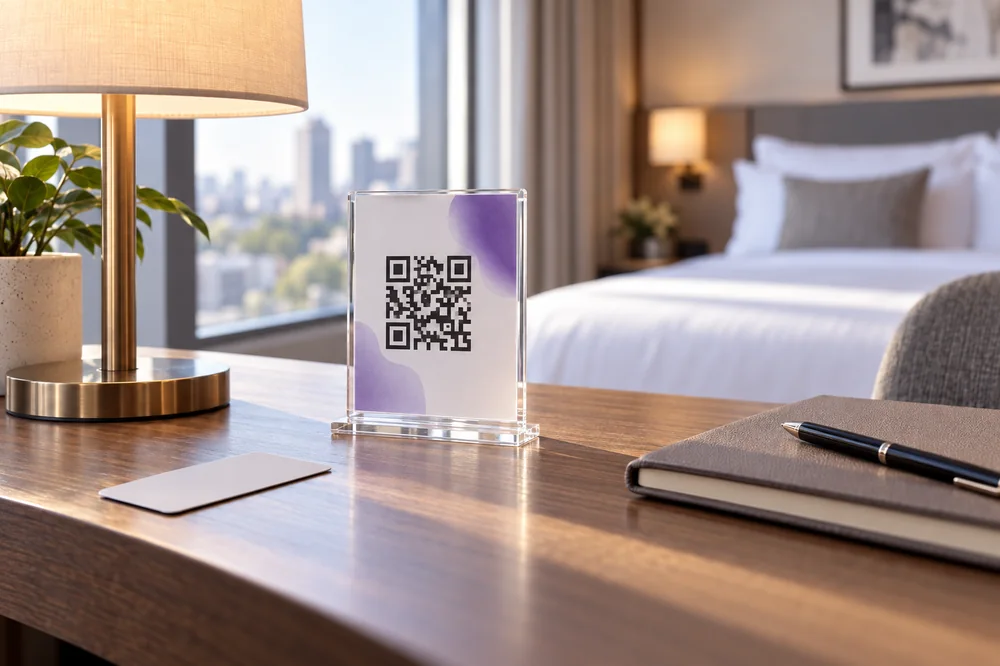
The in-stay version is for a QR card in the room or a tablet in the lobby. It is designed to catch a problem on the first evening, while you can still fix it:
- How is your stay so far?
Answer type: 1–5 smileys, required - Is there anything we can fix right now? (shown for 1–3)
Answer type: Multiple choice: Room cleanliness · Something not working · Noise · Temperature · Staff · Other - Your room number, so we can help straight away
Answer type: Short text, optional
In-stay versus post-stay guest satisfaction surveys
The two versions answer different questions and reach different guests:
- In-stay (short version) catches service failures while the guest is still in the building. A broken air conditioner reported at 9 pm can be fixed or the guest moved by 10 pm. The same complaint in a post-stay email can only be apologised for — or appears first in a public review.
- Post-stay (full version) measures the whole stay once the bill is paid and the guest can judge value for money. It produces the department-level scores management uses for planning.
Run both, and connect them: a guest who reported a problem during the stay should not receive a generic post-stay email, but a personal follow-up. For more ideas on collecting and using guest feedback, read our guide to customer feedback in hospitality.
When and where to run it
A hotel stay has several natural feedback moments. Use each one for a different version:
- First evening in the room — QR card on the desk or in the welcome folder, in-stay version. Encourage it at check-in: “If anything is not right, scan this and we will fix it.”
- Lobby and restaurant exits — tablet in kiosk mode, short version. Ask about breakfast or dining specifically at the restaurant exit.
- At checkout — QR code on the folio or a counter tablet, short version. Quick, but guests are often in a hurry.
- Within 24 hours after departure — email with a survey link, full version. The main post-stay measurement; send it in the guest's booking language.
- Events and conference guests — QR code in the meeting room, event version. Use the event feedback template for organiser-facing questions.
How to analyse the results
Track two headline numbers: overall satisfaction (share of 4–5 on question 1) and the recommendation score on question 10. Example: 410 post-stay responses in a month, 340 of them 4 or 5 — 83% satisfied. Then go department by department:
- Housekeeping: cleanliness score by floor or room type, and the share of “something not working” answers by room number — repeated rooms point at maintenance, not cleaning.
- Front office: check-in score by arrival time; late-night and peak afternoon arrivals often score lower.
- Food and beverage: breakfast score by day of week, excluding guests who did not use it.
- By purpose of stay: business and leisure guests value different things; compare them separately.
- In-stay recovery rate: of the guests who reported a problem during the stay, how many still gave 4–5 overall afterwards? This is the clearest measure of service recovery.
Closing the loop on low scores
Speed matters more in hotels than almost anywhere else, because the guest is still there:
- An in-stay score of 1–3 sends an instant alert to the duty manager with the room number and issue type.
- A ticket is opened and routed to housekeeping, maintenance or front office, with a target response time measured in minutes, not days.
- The duty manager confirms with the guest that the issue is fixed — ideally in person.
- Post-stay detractors (0–6) are followed up by guest relations; promoters can be invited to share a public review.
The full method is in closed-loop feedback.
Use this template in Qmeter
With Qmeter, the in-stay version runs on QR codes per room or floor and on lobby tablets, and the post-stay version goes out as an email campaign. Ticket generation rules route low scores and keywords such as “air conditioning” or “noise” to the right team with escalation if nobody responds, and every survey can be offered in more than 100 languages for international guests. Qmeter's Google reviews management sits alongside, so you see private and public feedback together. See hospitality for the full setup, or start the 14-day free trial.
Frequently asked questions
What questions should a hotel guest satisfaction survey include?
Overall satisfaction, purpose of stay, check-in, room comfort, cleanliness, whether everything in the room worked, breakfast and dining, staff, value for money, likelihood to recommend and an open comment.
When should hotels send a guest satisfaction survey?
A short in-stay survey on the first evening, through a QR code in the room, and the full survey by email within 24 hours after checkout.
How long should a hotel guest survey be?
Three questions for in-stay and lobby kiosks, and ten to twelve questions for the post-stay email. Guests rarely finish longer surveys.
Why run an in-stay survey as well as a post-stay one?
Because an in-stay survey lets you fix a problem while the guest is still in the hotel. A post-stay survey can only measure the problem after the guest has left.
Should the survey ask for the room number?
In the in-stay version, yes, as an optional field, so staff can act immediately. In the post-stay email it is usually known from the booking.
How do guest satisfaction surveys relate to online reviews?
Surveys give you private, structured feedback from many more guests than write reviews. Fixing issues raised privately reduces negative public reviews, and satisfied guests can be invited to post one.
Measure it at every location — live in one day
Feedback kiosks, QR and web surveys, SMS and email, real-time alerts and follow-up tickets in one platform. 14-day free trial.
✓ 15 minutes · ✓ No commitment · ✓ A real CX person